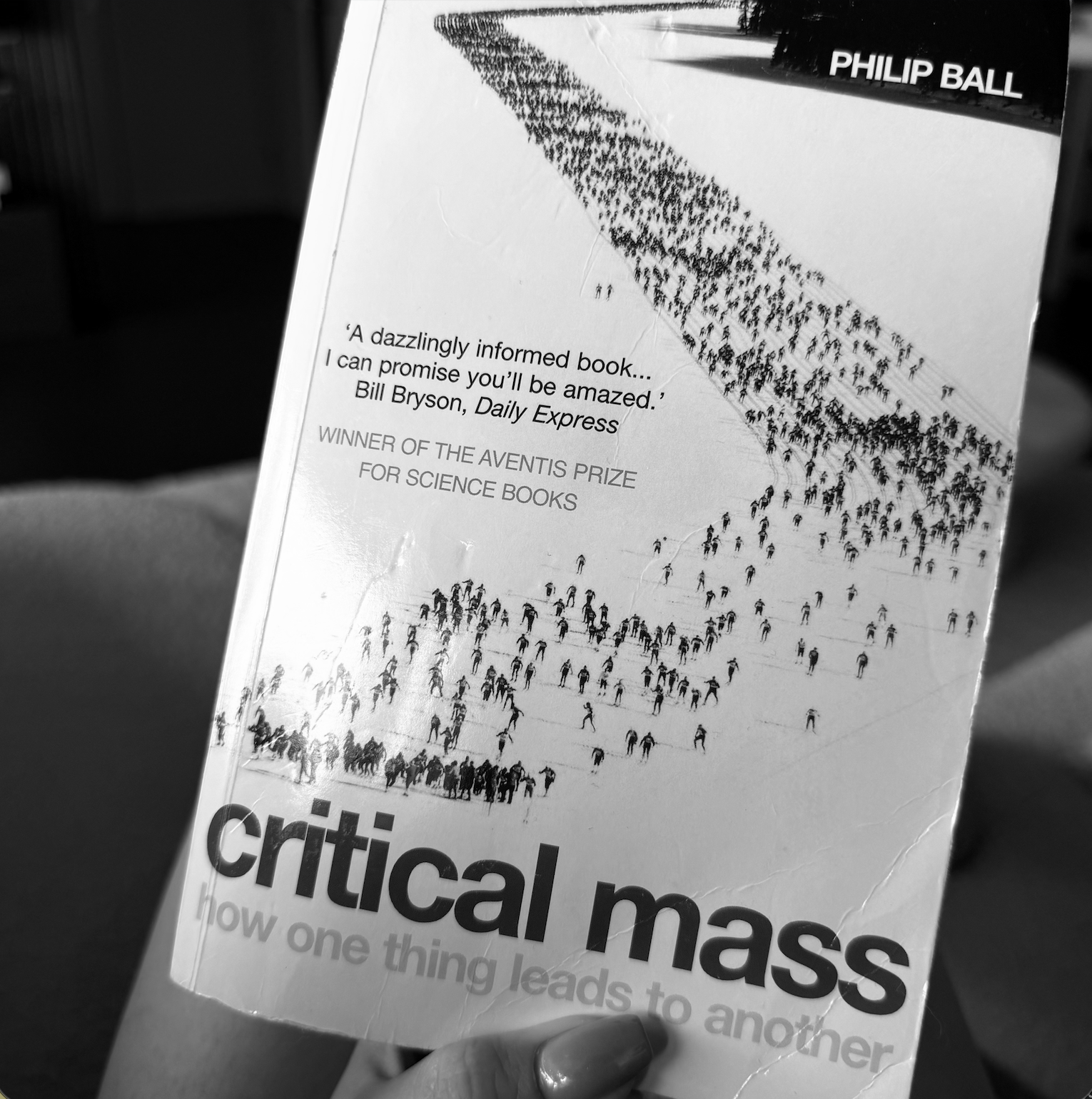
Critical Mass by Philip Ball
You are special, but together, we are not.
No one can say which lane a particular driver will drift into, when a given investor will lose their nerve and sell, or where a single family will choose to settle. Yet traffic jams, stock market crashes and segregated cities unfold with a regularity that borders on the eerie. That tension sits at the heart of Critical Mass: How One Thing Leads to Another by Philip Ball, a science writer and former editor at Nature.
Ball's central claim is that while individuals are unpredictable, large populations behave in strikingly orderly, almost lawful ways. His guiding analogy is a gas. Each molecule follows a haphazard path, yet the gas as a whole obeys precise laws of pressure and temperature. In the same way, when vast numbers of people interact, collective patterns emerge that no one designed, intended or even noticed according to the laws of mathematics and physics.
Remember the deadly Itaewon Halloween crowd crush in South Korea? On the night of 29 October 2022, more than 150 people died in a narrow, sloping alley in Seoul's Itaewon district. No one was running and no one set out to hurt anyone; the crowd simply became so dense that people could no longer breathe. Do you know mathematically how many people a space can safely hold before a deadly crush becomes possible?
This is not a book of loose psychological speculation, feel-good anecdote or guesswork about what people "really" want. Its foundations are physics, statistics and mathematical modelling. Ball's toolkit includes cellular automata, force-based simulations, power-law distributions, and network theory etc. Above all, he relies on the phase transition: the sudden shift from one collective state to another, as when water freezes into ice. Through this lens, he explains why societies can change abruptly once a tipping point, or "critical mass," (量變產生質變)is crossed. Perhaps most provocatively, the models he describes need to know almost nothing about anyone's inner life to reproduce what we actually observe in the world.
To summarize into a sentence most people instinctively would hate: You are special, but together, we are not.
The roots of social physics
Ball begins with history, and it is one of the book's quiet pleasures. He traces the idea of a "social physics" back to Thomas Hobbes, who tried in Leviathan to build a mechanical science of politics modelled on Galilean mechanics. From there he follows thinkers such as Adolphe Quetelet, who applied the astronomers' "law of errors" (what we now call the normal, or Gaussian, distribution) to human populations. Quetelet uncovered remarkable statistical regularities in rates of crime and marriage and coined the notion of l'homme moyen, the "average man." Individual acts seemed random, yet the yearly totals held almost perfectly steady.
Ball then reveals a surprising twist: these social statistics shaped the thinking of physicists such as James Clerk Maxwell and Ludwig Boltzmann. Maxwell encountered Quetelet's ideas through a review by the astronomer John Herschel, and the same statistical reasoning reappears in the Maxwell–Boltzmann distribution of molecular velocities, a cornerstone of statistical mechanics. Ideas flowed in both directions. Social science helped inspire one of physics' great achievements, and in this book physics returns the favour by turning its methods back on society. With that foundation in place, Ball applies modern physics and complexity science to a wide sweep of human behaviour, and the examples that follow form the core of the book.
Traffic jams with no cause
Traffic serves as one of Ball's most vivid illustrations of a phase transition. Early physical approaches, such as the Lighthill–Whitham–Richards model of the 1950s, treated traffic as a continuous fluid governed by equations of fluid dynamics, in which jams appear as "kinematic waves" or shock waves travelling along the road. Ball then turns to the more modern Nagel–Schreckenberg model (1992), a cellular automaton that divides the road into a row of discrete cells. Each car has an integer speed, typically from 0 up to a maximum of five cells per time step, and is updated by four simple rules: accelerate by one unit if there is room, slow down to avoid the car ahead, randomly brake by one unit with some probability p, and move forward.
That element of random braking is enough to generate "phantom jams": stop-and-go waves that ripple backward through traffic with no accident or bottleneck to explain them. The behaviour is captured in the so-called fundamental diagram, which plots traffic flow (cars per hour) against density (cars per kilometer). Flow rises with density up to a critical value, then collapses as congestion sets in, much as a vapour condenses into a liquid once it passes its saturation point.
Ball also draws on Boris Kerner's analysis of real data from German motorways, which led to Kerner's three-phase traffic theory: free flow, synchronized flow and wide moving jams. Traffic can also hover in a fragile, metastable state, and the transitions between phases show hysteresis, meaning the density at which a jam forms differs from the density at which it dissolves. The closest physical analogy is supercooled water, which can remain liquid below freezing until the slightest disturbance makes it crystallize at once.
Fat tails in financial markets
The conventional economic view dates back to Louis Bachelier's 1900 thesis, Théorie de la spéculation, which modelled price changes as a random walk, effectively Brownian motion, five years before Einstein's famous paper on the subject. Price changes were assumed to follow a Gaussian distribution, the familiar bell curve. On that assumption, a market move of five or more standard deviations should be so rare as to be practically impossible, yet such moves occur repeatedly in real markets.
Ball recounts how Benoit Mandelbrot, studying cotton prices in the 1960s, found that the real distribution has "fat tails" and proposed modelling it with Lévy stable distributions instead of the Gaussian. Later econophysics research, notably by H. Eugene Stanley's group at Boston University, analysed millions of stock trades and found that large returns follow a power law. The probability of a return larger than x falls off roughly as the inverse cube of x, a result known as the "inverse cubic law":
P(|r| > x) ∼ x⁻ᵅ, where α ≈ 3
Ball also notes a second statistical signature, volatility clustering: turbulent days tend to follow turbulent days, and calm follows calm. He discusses agent-based models, such as the Lux–Marchesi model of interacting "fundamentalist" and "noise" traders, that reproduce both effects. From this evidence, Ball builds a compelling argument: crashes are not freak accidents but an inherent feature of markets composed of interacting traders who tend to imitate one another.
The El Farol bar and the minority game
This is one of the book's most engaging examples. In a 1994 paper on "inductive reasoning and bounded rationality," the economist Brian Arthur imagined a bar in Santa Fe that is enjoyable only if fewer than 60 of its 100 potential patrons show up. Each person decides independently whether to go, using a personal set of rules of thumb, or "predictors," to forecast attendance from past weeks. The catch is that no strategy can be reliably correct: if everyone expects a quiet night, they all go and the bar is packed. Any prediction, once widely shared, undermines itself. In Arthur's simulations, attendance nonetheless fluctuates around the threshold of 60, as if guided by an invisible hand.
In 1997 the physicists Damien Challet and Yi-Cheng Zhang distilled this puzzle into the "minority game," in which an odd number of agents repeatedly choose between two options and the winners are those on the less popular side. Each agent remembers the last M outcomes and holds a few fixed strategies. Ball shows how such models generate fluctuations that closely resemble those of real markets. The key control parameter is the ratio of the number of possible histories to the number of agents:
α = 2ᴹ / N
At a critical value of roughly 0.34, the system's behaviour changes sharply. Below it, the market is "crowded" and fluctuations are large; above it, agents coordinate more efficiently. This is yet another instance of a phase transition, and one that physicists have analysed using the mathematics of spin glasses.
Crowds, lanes and panic
Remember the Halloween crowd crush in South Korea? On the night of 29 October 2022, more than 150 people died in a narrow, sloping alley in Seoul's Itaewon district. No one was running and no one set out to hurt anyone; the crowd simply became so dense that people could no longer breathe. Do you know how many people a space can safely hold before a deadly crush becomes possible? Crowd-safety researchers generally treat densities above roughly five people per square metre as dangerous, because beyond that point individuals lose control of their own movement and forces begin to travel through the crowd like a shock wave through a solid. Critical Mass was published long before Itaewon, but its account of crowd dynamics explains with uncomfortable clarity how such a disaster can unfold.
Drawing on the "social force" model developed by Dirk Helbing and Péter Molnár in 1995, Ball treats pedestrians as particles obeying Newton's second law. Each person's acceleration is the sum of competing forces: a driving force toward their destination at a preferred speed, and repulsive forces from other people and from walls that grow sharply as distances shrink. The resulting simulations capture, with uncanny fidelity, behaviour that anyone can observe in a real crowd.
When people walk through a corridor in opposite directions, they spontaneously organize themselves into lanes, a form of self-organization with no one directing it. At narrow openings such as doorways, the direction of flow oscillates back and forth in a regular rhythm. Helbing also identified a paradoxical effect he called "freezing by heating": adding more random jostling, or "noise," can destroy the orderly lanes and lock the crowd into a jammed, crystal-like state.
Most striking of all are the simulations of escape panic published by Helbing, Illés Farkas and Tamás Vicsek in Nature in 2000. People who try to move faster actually escape more slowly, because their pushing forms arch-shaped clogs at the exits, the same mechanism that jams grains flowing out of a hopper in granular physics. This is the counterintuitive "faster is slower" effect. The model even predicted that placing a column just in front of an exit can speed up an evacuation by breaking up those arches.
Segregation from mild preferences
Ball gives considerable attention to Thomas Schelling's segregation model, published in 1971 and one of the earliest agent-based models in social science. Schelling originally ran it by hand, moving coins of two kinds around a checkerboard. Each agent looks at its eight surrounding squares (its "Moore neighbourhood") and is content as long as a modest share of those neighbours, perhaps a third, are of its own type; otherwise it moves to a vacant square where it would be satisfied.
No one in this model wants a segregated neighbourhood. Even so, the population reliably sorts itself into sharply divided, homogeneous clusters, and the degree of segregation jumps abruptly once the tolerance threshold passes a critical value, a tipping point in the true sense. Physicists have since noted the close resemblance to phase separation, the process by which a mixed alloy or an oil-and-water emulsion spontaneously unmixes, and to versions of the Ising model of magnetism, in which neighbouring spins tend to align.
Ball's point is a sobering one: collective outcomes can be far more extreme than the intentions behind them, so we cannot simply read people's attitudes off the patterns their society produces. This is exactly why the book can set psychology aside. The pattern springs from the rules of interaction, not from anyone's state of mind.
Wealth, cities and power laws
Ball revisits Vilfredo Pareto's observation, made in the 1890s, that wealth in many societies follows a power-law distribution: the number of people with wealth greater than w falls off as a power of w, governed by what is now called the Pareto exponent. The popular "80/20 rule" is a loose descendant of this finding. A small fraction of the population holds a disproportionate share, and unlike a bell curve, the distribution has no natural "typical" scale.
He then outlines the 2000 model by Jean-Philippe Bouchaud and Marc Mézard, in which each person's wealth grows through random, multiplicative investment returns while also being exchanged with others through trade. Depending on the strength of trade relative to the randomness of returns, wealth either remains reasonably evenly spread with a Pareto tail, or "condenses," so that a handful of individuals end up controlling a finite fraction of all the wealth. The authors drew the mathematics from the physics of directed polymers in random media, and the condensation is a genuine phase transition. Related ideas trace back to Gibrat's law of proportionate growth, which holds that a firm's growth rate is independent of its size and naturally produces highly skewed distributions.
Ball ties this to Zipf's law, the empirical rule that a city's population is roughly inversely proportional to its rank:
S(r) ∝ 1 / r
So a country's second-largest city tends to be about half the size of its largest, the third about a third, and so on down the ranks. Similar power laws appear in the size distribution of firms, which Ball presents as further evidence that economies share statistical fingerprints with physical systems.
Small worlds and scale-free networks
Ball starts with Stanley Milgram's 1967 letter-forwarding experiment, in which packages passed between acquaintances reached a target in Boston in about six steps on average, the origin of "six degrees of separation." He then sets out the mathematical background. In the random graphs studied by Paul Erdős and Alfréd Rényi, links are placed between nodes purely at random, and a single "giant component" connecting most of the network appears suddenly once the average number of links per node exceeds one. This is a percolation transition, another phase transition in disguise.
The 1998 Watts–Strogatz model bridges two extremes: a regular lattice, where neighbours of neighbours are also neighbours (a high clustering coefficient) but distances are long, and a random graph, where distances are short but clustering is low. Duncan Watts and Steven Strogatz showed that rewiring even a tiny fraction of links at random sharply reduces the average path length while leaving clustering almost untouched. The result is a "small world": tightly knit locally, yet globally only a few steps across. Ball connects this to Mark Granovetter's sociological idea of the "strength of weak ties," the casual acquaintances who bridge otherwise separate social circles.
He goes on to explain Albert-László Barabási and Réka Albert's 1999 model of preferential attachment, in which new nodes link to existing ones with probability proportional to how many links those nodes already have ("the rich get richer"). This produces a scale-free network, whose degree distribution follows a power law:
P(k) ∼ k⁻ᵞ, where γ ≈ 3
Here P(k) is the probability that a node has k links. The result is a network dominated by a few highly connected hubs. This structure accounts for a striking paradox, demonstrated by Réka Albert, Hawoong Jeong and Barabási in 2000: such networks are resilient to random failures yet acutely vulnerable to targeted attacks on their hubs, with consequences for the internet, the spread of disease and the flow of social influence.
Cooperation and alliances
On the question of how cooperation evolves, Ball turns to game theory and the prisoner's dilemma. Two players each choose to cooperate or defect, and the payoffs are ranked so that the temptation to defect (T) beats the reward for mutual cooperation (R), which beats the punishment for mutual defection (P), which beats the "sucker's payoff" (S):
T > R > P > S
In a single game, defection is the rational choice, which makes it the Nash equilibrium, even though both players would be better off cooperating. Robert Axelrod's computer tournaments of the 1980s explored what happens when the game is repeated. The winner was "tit-for-tat," submitted by the mathematician Anatol Rapoport: cooperate first, then mirror the opponent's previous move. Its success showed how reciprocity can make cooperation stable.
Ball also describes Martin Nowak and Robert May's 1992 spatial version, published in Nature, in which players on a two-dimensional lattice play only against their immediate neighbours and copy whichever neighbour scored best. Depending on the size of the temptation to defect, cooperators and defectors form shifting, kaleidoscopic, fractal-like patterns, and within them cooperation manages to survive in clusters, something impossible in the well-mixed version of the game.
In a related vein, Axelrod and D. Scott Bennett's 1993 "landscape theory of aggregation" treated nations' choice of allies as a physical system settling into its lowest-energy state. Each pair of countries was assigned a "propensity" to align, based on factors such as ethnicity, religion, border disputes and type of government, and the model searched for the configuration that minimized the total "frustration" across all pairs. Fed data on 17 European countries in 1936, it predicted the Second World War alliance split with striking accuracy, misplacing only a couple of countries. The impossibility of satisfying every pairwise preference echoes the "frustration" found in magnetic materials known as spin glasses, where competing interactions between atomic spins prevent any arrangement from satisfying them all.
This is a thick copy of 644 pages packed with a vast variety of examples, I could only pick out a few interesting ones. What unites these examples is a single, powerful insight: simple rules of interaction, repeated across vast numbers of people, give rise to large-scale patterns and sudden transitions that could never be deduced from studying any one individual. Seen through Ball's lens, a traffic jam becomes a phase transition, a market crash a statistical inevitability written into fat tails, and a segregated city the predictable outcome of a modest rule played out on a grid.
Ball is careful not to overstate his case. He readily concedes that people are not particles and that these models have genuine limits. Still, he makes a persuasive argument that they offer real insight, and he engages thoughtfully with the political and philosophical questions they raise about free will and how far social outcomes can be predicted or engineered.
The book earned wide acclaim and won the Aventis Prize for Science Books in 2005. It is a rewarding read for anyone drawn to complexity science, the history of ideas, or the meeting point of physics and the social sciences, and especially for readers who want to see how far mathematics, statistics and physics can take us toward understanding ourselves.