
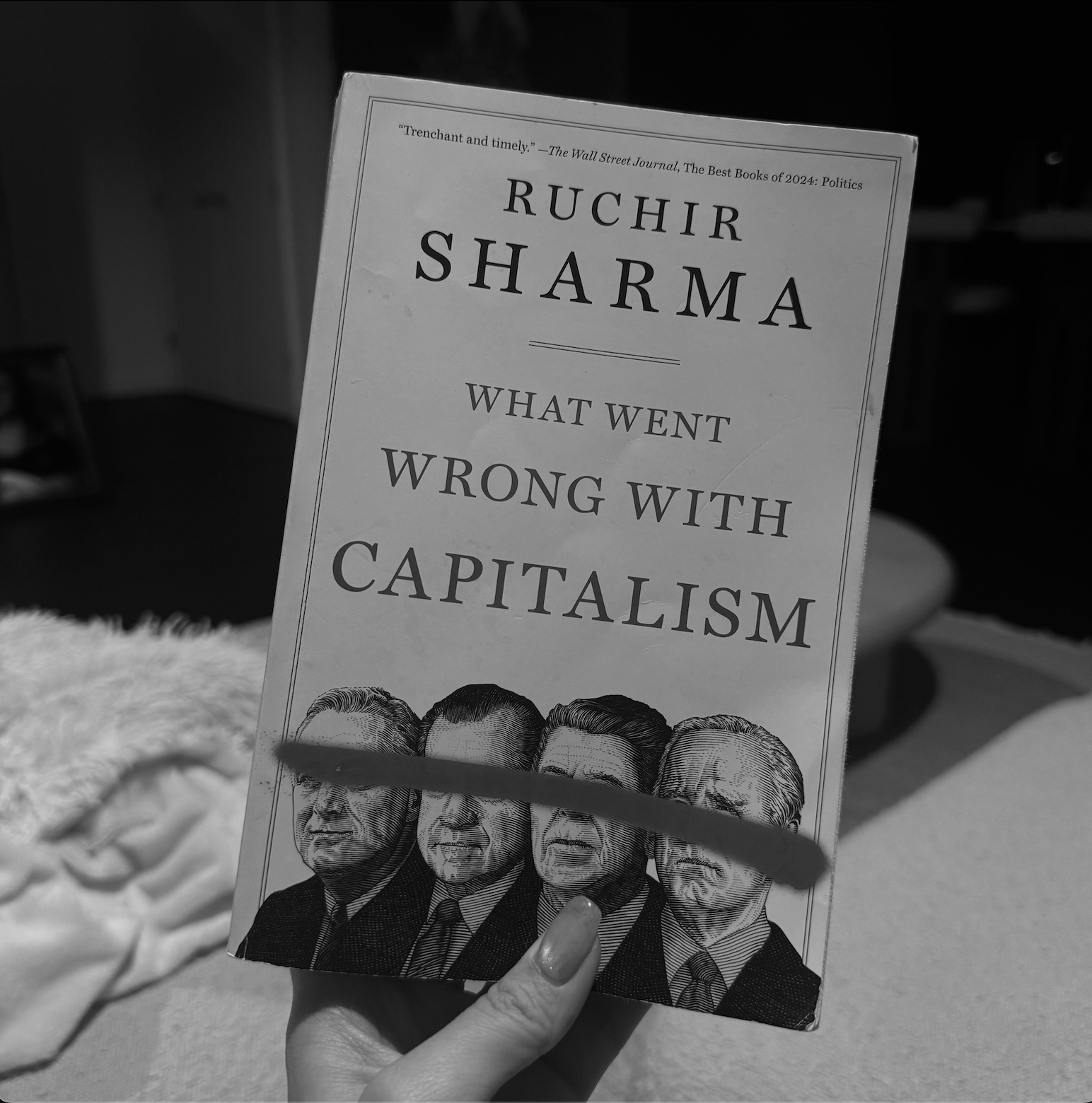
What Went Wrong With Capitalism by Ruchir Sharma
By now, the familiar indictments of capitalism have become a litany: the widening gulf between the affluent and the struggling, the rise of corporate monopolies, recurrent financial crises, the fading myth of the invisible hand, and the perceived failure of markets to deliver broad prosperity.
Millennials, the cohort poised to assume the reins of power, have largely internalised this narrative—convinced of capitalism’s ailments, which, in my view, have mostly stood beyond dispute, yet perhaps too certain of their provenance.
At business schools, we were taught—or at least I was—that we once believed in Adam Smith’s invisible hand: the notion that markets, left to themselves, would find equilibrium. Then came the crises, and with them a new orthodoxy: laissez-faire had failed, neoliberalism was the culprit, and salvation lay in government regulation. The verdict was rendered with near-theological certainty. Case closed. The 2008 financial crisis, we were told, proved that government oversight had been too lax—too little government. Case closed tightly again.
It is true that government did not regulate the Wall Street enough.
Yet, question:
How did that torrent of capital flood into the financial markets in the first place?
Was it through the invisible hand? No, it was not conjured by the invisible hand but unleashed by the very visible one—government debt and monetary excess. Now, another question:
Can capitalism, as a system, fully be faulted when what we practise bears so little resemblance to its classical design?
Perhaps the pathology lies not in too little state, but in too much—a government swollen by its own interventions, perpetuating cycles of distortion under the guise of correction.
Millennials, the generation now shaping the political mainstream, have embraced a narrative that is clear about capitalism’s maladies, but far too certain of their origins. The ailments of modern capitalism are real; but given the misdiagnosed causes, the prescribed cure may not be.
The book What Went Wrong with Capitalism by Ruchir Sharma seeks to reframe this entire debate by turning the mirror back on government excess—arguing that capitalism’s current ailments stem not from too little state intervention, but from too much of it. Sharma traces the history of American governance from its earliest stirrings: the federal government, established under the Constitution in 1789, was minimal, tasked primarily with delivering mail and performing basic functions. Early debates between America’s founding fathers, Alexander Hamilton, who pressed for a robust centralized state, and Thomas Jefferson, who espoused restrained governance, established competing visions for the young nation. Over time, historical exigencies—the Civil War, industrial consolidation, the Great Depression, and the World Wars—incrementally expanded the state’s economic role, embedding interventions that, while often necessary, laid the groundwork for the distortions now afflicting modern capitalism.
Sharma argues that as government expanded, it began to disrupt the natural dynamics of creative destruction: bailouts and easy credit forestalled the failure of inefficient firms, misallocated capital, and propelled cheap money into the financial sector. These interventions, intended to stabilize, paradoxically caused systemic fragilities and concentrated economic power, seeding recurrent crises.
The title of this book seems to indicate that there was a time when all was right with capitalism, or at least most things were. Sharma scotches that expectation in an early chapter, declaring that there was no golden age. In popular perception, the US is the home of capitalism, the acme of its perfection. In Sharma’s telling, the US is a case study of all that is wrong.
Too Much Government Aid Stifles Creative Destruction and Productivity
To understand the distortions wrought by government overreach, we must first recall the logic of capitalism itself—an engine designed to propel growth through competition and restraint, not orchestration.
Economic growth rests on two pillars: the number of people in work and the output each worker can generate. In an era of demographic stagnation, the burden of sustaining growth has shifted decisively to productivity— the capacity to do more with less. Productivity gains enable firms to lift wages without stoking inflation, expanding prosperity on a stable foundation. Yet since the 1980s, productivity growth has decelerated sharply. A neglected culprit, Sharma argues, lies in the swelling reach of government and its offshoots—surging public debt, financial repression, and chronic misallocation of capital.
When capitalism functions as intended, it does so through what Joseph Schumpeter famously described as “creative destruction”: the relentless process by which new firms displace the complacent and the obsolete, driving efficiency and renewal. Yes, destruction. But repeated government interventions—rescuing the failing, subsidising the stagnant—have dulled this essential rhythm. Each crisis begets larger bailouts; each downturn spares more of the unfit. The United States, once celebrated as the land of second chances, has become the land of no exits. Since the dot-com crash, recoveries have grown longer but more languid, markets more stable yet less discerning. Investors now cheer both good news and bad—confident that misfortune will summon fresh liquidity and state support.
By cushioning capitalism from its own corrective mechanisms, the modern state has blunted its dynamism. The result is slower productivity, anaemic long-term growth, coddled incompetent businesses, and an ever-greater concentration of wealth among those insulated from failure.
Historical Growing Reliance on Government Support
Since when did we become so reliant on government support, assuming a continual cushion as our entitlement? And how did we come to equate the absence of economic pain with economic health?
Sharma pointed out that since the Depression of the 1930s, governments in advanced economies have assumed an increasingly interventionist role in the allocation of capital, whether through regulatory oversight, bailouts, or expansive fiscal and monetary measures. Today, even the faintest tremor in financial markets prompts swift action—liquidity injections, interest-rate adjustments, and targeted bailouts—designed to pre-empt systemic instability.
After the Great Depression, the developed world grew hooked on debt—and on the illusion that governments could engineer uninterrupted prosperity. What began as a pragmatic Keynesian tool, meant to smooth the business cycle through countercyclical spending, morphed into a permanent addiction. The original prescription, to run deficits in recessions and surpluses in booms, was quietly abandoned. In its place emerged a doctrine of endless stimulus, a refusal to accept even the mildest downturn as a natural corrective. Democracies, once capable of restraint, began to lose their ability to make hard choices, or to accept any pain. Legislatures fractured along ideological and cultural lines—over race, immigration, and identity—paralysing fiscal decision-making. Responsibility for growth drifted from elected officials to unelected central bankers, whose mandates expanded far beyond monetary stability into the realm of social engineering.
We have no pain tolerance these days. The transformation bears an uncanny resemblance to the modern revolution in pain management that left America dependent on opioids –markets and voters came to regard any economic pain as unacceptable. Every shock demanded a larger dose of relief—lower rates, looser policy, greater bailouts. By 2020, the scale of intervention reached narcotic proportions. A welfare system once designed to protect the destitute had metastasized into a safety net for asset holders. Each crisis swelled financial markets further, as liquidity injections lifted valuations detached from real productivity. The result is an economy sedated by cheap money, where creative destruction is dulled, risk is socialised, and prosperity increasingly depends on the next fix from the state.
Capital Misallocated: Government Intrusion and the Wall Street Surge
When governments assume the role of dominant buyer and seller, not the invisible hand, they distort the price signals that normally guide capital. Money flows not to the most promising ventures but along the paths of least regulatory resistance or heaviest state backing. Each crisis triggers ever-larger bailouts, deepening debt and leaving capitalism increasingly fragile.
In the 2000s, and with even greater intensity in 2010, advanced economies funneled massive capital into markets that were recovering rather than collapsing. Intended to stimulate growth, these interventions often produced the opposite effect. By injecting cheap credit, governments channeled vast sums into the financial markets and Wall Street, creating over-leveraged incumbents and inflating asset prices. During the pandemic, these distortions reached extreme proportions: trillions flowed indiscriminately into firms large and small, solvent or otherwise, prompting investors to chase whatever the central bank or Treasury supported rather than enterprises with genuine economic potential.
While some liberal commentators attribute the post-Reagan surge in financial markets primarily to deregulation, Sharma urged the readers to ask the same question: How did the capital flow into the financial market in the first place? Again, Sharma argued that the underlying driver was the preponderance of capital flowing from government and central banks. Proliferation of cheap money inflates asset prices across the board, engorging markets beyond the scale of underlying debt. By the onset of the pandemic, U.S. financial markets had swollen to an eye-watering $120 trillion—roughly four and a half times the size of national GDP.
Cheap Money, Deficits, and Political Hazards
Throughout the book, Sharma examined the structural consequences of persistent budget deficits and the systematic devaluation of money, showing how these trends have shaped modern capitalism’s political and economic landscape. From the 1970s, most advanced capitalist economies began running significant deficits more than a percentage point of GDP. Deficits mean cheap money, which leads to a loss of discernment. If economic agents cannot tell between a smart application of capital and its opposite, bankruptcy is constant, creating political compulsion to cheapen money further. This cumulative logic leads to financial meltdown, with politically hazardous consequences. Governments trapped in the cycle have no recourse except digging in deeper with progressively larger bailouts.
Research has established that many of modern capitalism’s banes stem from cheap money: growing monopolies, extinction of small businesses, and rising income and wealth gaps, particularly stagnation for the bottom 50 percent.
Landmark histories of capitalism in 2022 and 2023 misdiagnosed Reagan-era economics as small government, but Sharma points out the US federal budget broke all bounds of prudence due to high interest rates, huge tax cuts, and massive military spending. Since then, deficits have remained, with brief relief in the late 1990s under Clinton, quickly squandered by George W. Bush’s tax-cut obsession. Corporate and household debt rose to record levels at the cusp between the Clinton and Bush terms. Schumpeter’s “creative destruction” had to be managed through strategic state intervention in democratic societies; extinction of large parts of the economy could trigger political upheaval. US deficits mounting relentlessly since the 1980s are an exercise in seigniorage: the privilege of issuing global reserve currency debt, enabling the US to borrow from the world. That privilege, Sharma notes, is wearing thin because of the promiscuity with which the US has used the dollar as a strategic weapon. The global crisis of capitalism will not be resolved technocratically but through political means—and those maneuvers are already under way.
So what went wrong with capitalism? When it works, capitalism allows individuals to vote in the marketplace, investing in new ideas and nurturing companies. Their decisions shape prices, which reflect the collective judgement on which ventures are likely to succeed. The dispersed wisdom of millions of investors scrutinising every opportunity cannot be replicated by the lone mind of the state. Yet today, what we call capitalism heavily relied on the lone mind of the state intervening, thus undermining the system’s very fundamental logic.
Do I agree with everything said in this book? Not necessarily. However, all in all, this is a well-written book that combines rigorous analysis with a compelling narrative, offering valuable insights and some thought-provoking questions.