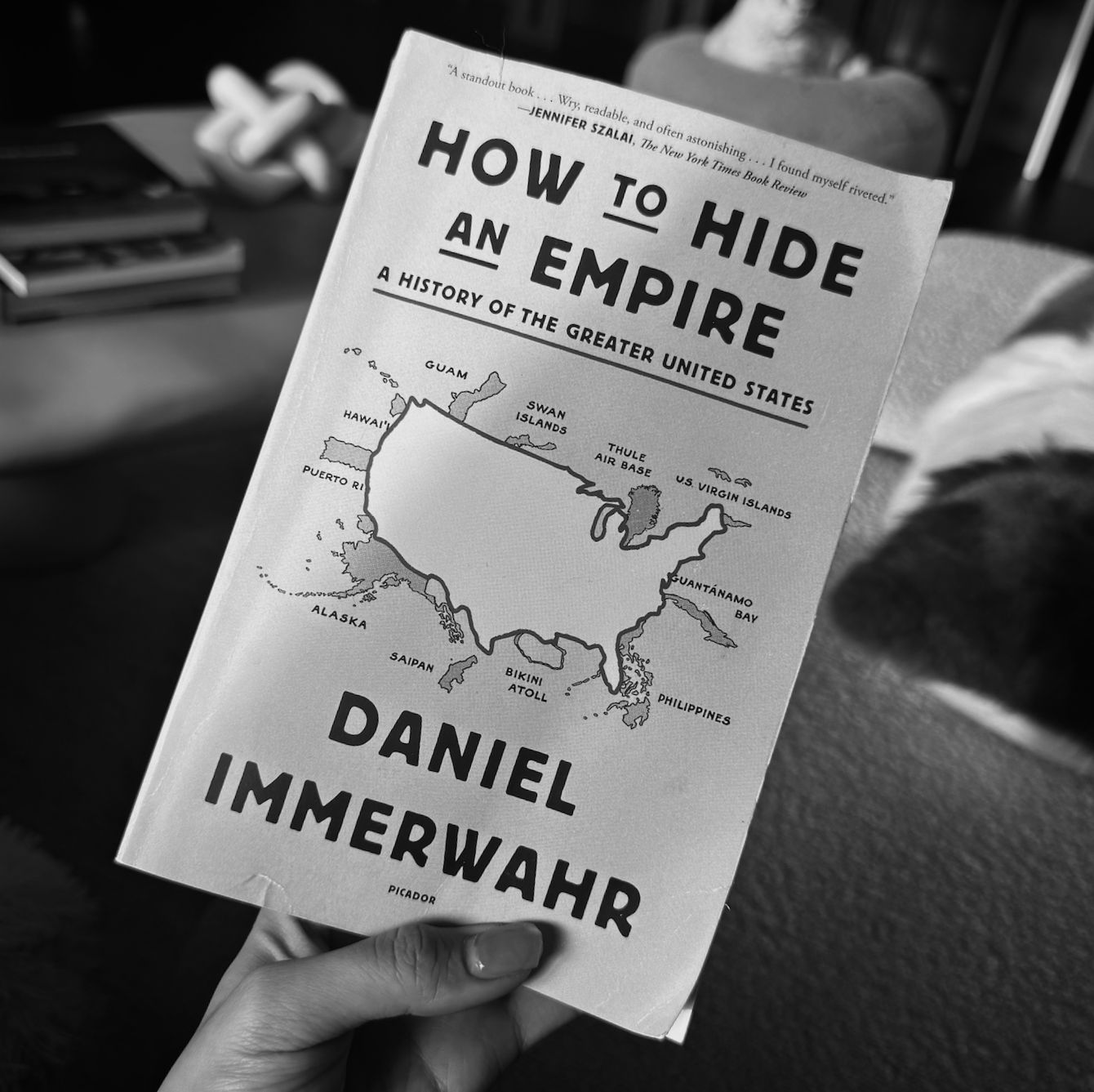
How to Hide an Empire by Daniel Immerwahr
In American parlance, “empire” is a handy label reserved for everyone else—never, heaven forbid, for the United States itself.
Perhaps one of the most striking ironies in the annals of modern warfare lies here:
The site most irrevocably etched in memory for Japan’s attack, Pearl Harbor, was the only U.S. territory NOT taken amid Japan’s sweeping offensives.
Meanwhile, across the Pacific, entire U.S. territories fell with alarming rapidity: Guam captured, Wake besieged, the Philippines devastated and annexed under duress. Yet Pearl Harbor alone, unconquered, was chosen as the nation’s rallying emblem.
Indeed, all the other territories were legally American, yet, it was exclusively that which lay within symbolic proximity to the continental homeland that was cherry-picked to be broadcasted to the nation.
The ink upon President Roosevelt’s seminal “Infamy” speech was barely dry when he annulled “Hawaii and the Philippines” and substituted it with “the American island of Oahu”, compressing a sprawling imperial calamity into a narrowly American tragedy.
Why did Roosevelt do that?
What impelled Roosevelt to undertake so deliberate a rhetorical reconfiguration?
Well, because verbiage matters. The true geography of the United States, its far-flung archipelago of territories scattered across the Pacific, was never fully acknowledged by the mainland public, nor entirely embraced in the national imagination. Legally, the Philippines, Guam, and Wake were unmistakably U.S. soil; yet to many Americans they remained distant, foreign, and faintly peripheral. Hawaii, by contrast, could be rhetorically rounded up into Americanness: closer to the continent, whiter in composition, and already spoken of as a future state. To summon a unified public fury, Roosevelt had to anchor the narrative in the one territory his listeners instinctively recognized as their own.
But why did the other territories fail to register in the public imagination as parts of the United States? What happened to the collective memory of the citizens?
One of the reasons is not hard to guess.
Deeply wedded to the narrative of its republican virtue, the United States recoils reflexively at the unflattering terms “empire”, “colonies”, and “imperialism”. After all, within the American vernacular, the disparaging term “empire” is a label perpetually ascribed to others, never, heaven forbid, to the United States.
The nation was born in an anti-imperialist revolt and has fought empires ever since. The U.S has since cast itself as the underdog fighting the big guys, the perennial adversary of empires—from Hitler’s Thousand-Year Reich and the Japanese Empire to the so-called evil empire of the Soviet Union. Opposition to imperial ambition is not confined to history; it extends into the cultural identity. Star Wars, a franchise that commenced with a rebellion against the Galactic Empire, stands among the most commercially successful film series of all time. So hell no, the United States cannot be an “empire”, even as it continues to play the role with unmistakable enthusiasm.
This self-conception as a principled, quasi-virtuous republic is reassuring, but it carries tangible costs. Most of the cost has been paid by those living in the colonies, in the occupation zones, and around the military bases. Public messaging is engineered: inconvenient truths are swept under the rug, and the collective memory of the mainland citizenry carefully curated to sustain a coherent national narrative.
But some may still question: If the United States was, in substance, an empire, why did it choose to free some of its territories after the world wars?
Why did the United States, at the height of its global influence, deliberately distance itself from the traditional architecture of colonial empire?
In the book How to Hide an Empire, author Daniel Immerwahr lays bare the United States as a republic in name but an empire in praxis, its hegemony extending far beyond the continental mainland, yet somewhat hidden, with colonies curiously absent from the nation’s sense of itself. Immerwahr interrogates the systematic erasure of its colonies, from Puerto Rico and Guam to the Philippines and scattered Pacific islets, excised from maps and public consciousness alike. These territories, he shows, were governed with ruthless attention to strategic, racial, and economic calculation, denying their inhabitants full citizenship while maintaining the illusion of democracy. Even the freeing of some colonies after WWII was hardly a matter of conscience: post–Second World War technological, logistical, and cultural innovations allowed the United States to project power more subtly, without the encumbrance of territorial administration. By exploiting advances in electronics, transport, and soft power, the United States devised a “pointillist empire,” sustaining global supremacy through a lattice of military bases, economic leverage, and cultural penetration rather than conventional colonial rule. In demonstrating these hidden mechanisms, Immerwahr compels a reevaluation of American history, revealing an empire whose obscured reach has profoundly shaped both the nation’s self-image and its capacity to shape the world.
The author parsed the history of the Greater United States into three acts.
Act one is continental, it traces the 19th-century relentless westward drift of borders, accompanied by the dispossession of Native Americans. Familiar, perhaps, but a fresh lens on territory reveals surprises. Consider the 1830s creation of a vast, ostensibly all-Indian domain—arguably America’s first colony.
By mid-century, act two, the republic’s tentative outward turn, was emerging, as Americans began to covet peripheral possessions in the Caribbean and the Pacific.
These territories were inhospitable, sparsely populated, and barren. Why on earth would the United States want those random land? Well, they had bird poop.
Yes, bird poop. Their primary utility lay in nitrogen-laden guano, a fertilizer deemed essential to remedy the “soil exhaustion” afflicting an industrialising nation. The Guano Islands Act of 1856 stipulated that any uninhabited, unclaimed island upon which an American citizen discovered guano may, at the discretion of the president, be considered as “appertaining” to the United States.
“Appertaining” was a curious, almost evasive term, as if the law drafters were mumbling through the pivotal clause. It suggested an ambivalence that would quickly dissipate. Theodore Roosevelt, then assistant secretary of the navy, pursued the Spanish–American War of 1898 with the fervour of a man steeped in Anglo-Saxon superiority.
Subsequent decades, between 1898-1900, the nation moved towards the spoils of Spain’s crumbling empire— the annexation of Puerto Rico and the Philippines, the suppression of independence movements with ruthless efficiency, and the imposition of draconian practices on Filipino insurgents, including the notorious water cure. Mainland physicians were effectively deputised to experiment upon Puerto Rico as a quasi-medical laboratory. Viewed through Immerwahr’s lens, even well-trodden historical episodes acquire a discomfiting acuity. The Second World War in the Philippines, for instance, which combined American bombardment with Japanese atrocities, is cast as by far the most destructive event ever to take place on U.S. soil.
Racial ideology pervaded these imperial ventures, often in counterintuitive ways. While expansionists professed to “civilize” the “savages,” some of the most vehement anti-imperialists, such as South Carolina senator John C. Calhoun, opposed annexation on the grounds of white supremacist exclusivity. The 1867 acquisition of Alaska likewise provoked resistance, with The Nation decrying the prospect of Eskimos fellow citizens. As Immerwahr wryly notes, The deal went through only because, in the end, there weren’t that many Eskimos, and there was quite a lot of Alaska.
Philippines, Puerto Rico, Guam, Alaska—alongside Hawaii, Wake Island, and American Samoa. By 1917, the U.S. Virgin Islands were added. By World War II, these territories constituted nearly a fifth of the nation’s total land area. Expansion, it seems, was both instinctive and conventional: more power, more land. Yet, these colonies were rarely shown on the map, only hidden in the footnotes.
Then comes Act three, the narrative culminates in the post-Second World War era, when the United States began relinquishing territory—an unusual departure for a victorious power.
Instead of converting occupations into formal colonies, the United States gave territory away. The Philippines gained independence; Puerto Rico became a “commonwealth”; Hawaii and Alaska, after decades of exclusionary prejudice, became states. At the very moment of peak global authority, America seemingly disavowed empire.
To answer one of the questions stated earlier, if America was indeed imperialistic, why did it free some of the territories?
Partly, because the colonized refused submission. Domestically and abroad, resistance reshaped relationships and impeded conquest. But more importantly, because technology made empire redundant.
Technological innovation had attenuated the linkage between dominion and power: synthetic substitutes reduced the strategic value of raw materials…. with the notable exception of oil, the one raw material that has most reliably tempted politicians back into the old logic of empire. Aviation, plastic, radio, and logistical innovation allowed the United States to project power globally, exploit resources, and standardize commerce without annexation. Empire was replaced by globalization—deliberately engineered, astonishingly fast, and centred on one country.
Thus, the release of the colonies was less a triumph of moral scruple or principled restraint than a by-product of structural reconfiguration, one that aligned conveniently with America’s long-nurtured aspirations to global logistical pre-eminence.
The contemporary United States presides over a “pointillist empire”: a constellation of strategic outposts serving as bases, logistical hubs, detention centres, and other facilities. The United States maintains roughly 800 overseas bases; Russia, nine; most countries, none. If Roosevelt embodied the audacity of formal empire, Herbert Hoover, an astonishingly capable bureaucrat, prior to a less distinguished presidency, symbolised the ascendancy of standardisation, logistics, and globalised administration.
Immerwahr narrates with such assurance that even Hoover’s campaign for uniform screw threads becomes unexpectedly compelling. Yet the book’s achievement lies in more than its accumulation of arcana. How to Hide an Empire combines panoramic sweep with forensic attention to detail, yielding a portrait of the United States not as it imagines itself, but as it actually is.
The book contains many nuances and engaging historical moments that can’t all be addressed in this review. The writing is light and enjoyable, and although I hope to capture its spirit here, I know I can’t fully do it justice. For those seeking to reconsider the contours of American history through a fresh perspective, this volume will prove a rewarding choice.