
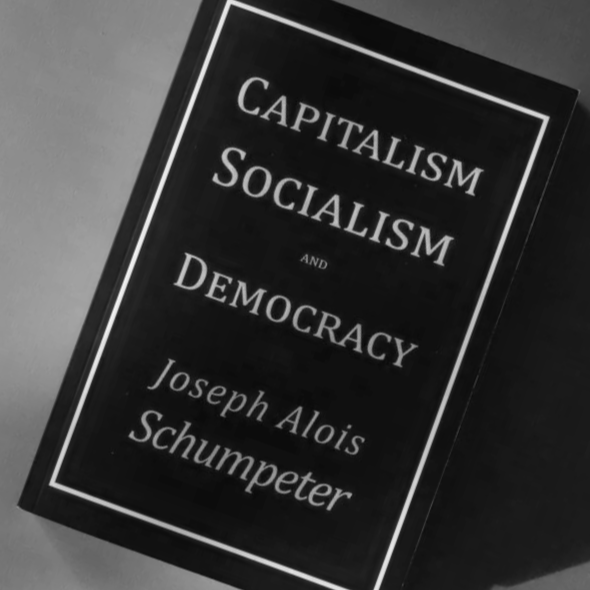
Capitalism, Socialism, and Democracy by Joseph Alois Schumpeter
Occasionally I get asked as to how I alight upon the next book. Yet once you begin reading, you find yourself going down a rabbit hole: each footnote, citation, epigraph, conjecture, even every opposing argument aside, becomes a small aperture onto further texts, drawing you inexorably toward the next book.
Just recently I wrote a review of What Went Wrong With Capitalism, a volume in which the author maintains that government intervention has profoundly distorted the working of “creative destruction.” Coined by the economist Joseph Alois Schumpeter, the notion refers to the ceaseless, dislocating churn by which innovation renders existing firms, technologies and jobs obsolete, reallocating capital and labour toward more productive uses. In pursuit of a more nuanced understanding of this, I was drawn to this landmark volume: Capitalism, Socialism, and Democracy. Wikipedia records this book as the third most cited work in the social sciences published prior to 1950, trailing only The Wealth of Nations and Das Kapital. Its intellectual reach, somehow it had escaped my notice.
Capitalism: we are all acquainted with its flaws, yet in recent years it has almost become a synonym for evil. The prevailing climate of hostility to capitalism renders it far more difficult than it need be to arrive at a rational assessment of its economic and cultural record. Public opinion has, by now, become so thoroughly alienated from the system that its denunciation is largely taken for granted—almost a matter of decorum in public discourse.
Whatever their political persuasion, commentators hasten to observe this convention: they underscore their critical distance, proclaim their immunity to “complacency,” insist upon the shortcomings of capitalist achievement, profess their distaste for capitalist interests and their sympathy for anti‑capitalist causes. Any contrary stance is not merely dismissed as incorrect but stigmatized as an indication of immoral servitude.
Regardless, Joseph Alois Schumpeter, pro-Capitalism is very ready to support and defend Capitalism. Interesting enough though, he started by asking
“Can Capitalism last?”
And gave the resounding answer of
“No.”
In Capitalism, Socialism, and Democracy, Joseph Alois Schumpeter delivers a deliberately unsentimental anatomy of modern capitalism, stripping it of equilibrium fantasies. For all the virtues he attributes to capitalism, Schumpeter is unambiguous in his expectation that it will eventually exhaust itself and give way to socialism. He rejects Marx’s historical materialism and the crude determinism of class struggle, yet arrives at a similarly unsettling destination: capitalism, he argues, is perfectly capable of engineering its own demise.
What is Capitalism? Per Schumpeter’s definition, it is not a self-correcting machine tending toward harmony, but a volatile historical process propelled by innovation and creative destruction, a ceaseless cycle in which new technologies, firms, and organizational forms annihilate their predecessors. Growth, in this view, is not the reward for stability but the byproduct of perpetual upheaval. The entrepreneur, not the market in repose, is capitalism’s true protagonist, and even this figure, Schumpeter suggests with thinly veiled irony, is destined for extinction once capitalism matures enough to systematize its own revolutions.
The book’s most disquieting claim is that capitalism’s gravest danger lies not in crisis or inefficiency, but in triumph. Precisely because capitalism works, because it generates unprecedented wealth, productivity, and technological mastery, it corrodes the social and cultural conditions that once sustained it. Innovation becomes bureaucratized, folded into the routines of large corporations and administered by committees rather than driven by audacious individuals. Ownership dissolves into shareholding, entrepreneurship into management, and capitalism gradually loses the class of proprietors who once had both the incentive and the instinct to defend it. What remains is a system that continues to perform brilliantly while inspiring remarkably little loyalty.
Schumpeter sharpens the knife further by turning capitalism’s cultural achievements against it. Capitalism mass-produces intellectuals—educated, articulate, and professionally rewarded for critique rather than stewardship. These intellectuals, lacking property yet armed with influence, supply a steady stream of ideological hostility toward the very system that sustains them. Democratic politics compounds the problem: mass electorates, understandably impatient with inequality and disruption, pressure capitalism through regulation, redistribution, and short-term political demands. The result is a slow political strangulation of a system that remains economically vigorous but socially indefensible. Socialism, in this account, does not arrive as a utopia or even as an improvement, but as a successor regime made plausible by capitalism’s self-inflicted exhaustion.
One of Schumpeter’s most provocative thoughts, in my opinion, is that he argues as a matter of economic reasoning, that there is no intrinsic reason a centrally planned socialist economy could not function with an efficiency broadly comparable to that of our decidedly imperfect market system. Whether this claim was defensible in 1943 is open to debate. In an era of high-speed computation, networked information, and large-scale data analytics, however, it is no longer absurd to imagine a centrally planned economy operating tolerably well—perhaps even along the lines Schumpeter sketched with such disconcerting calm.
The book then turns to democracy, where Schumpeter is again at his most unsentimental. He argues, persuasively, that neither capitalism nor socialism carries any necessary commitment to democratic governance, again, provocative. Economic systems, in his telling, are morally indifferent to political form. Although he ultimately endorses democracy, the version he defends is conspicuously elitist and likely to unsettle those who cling to more romantic notions of popular rule.
At this point, his intellectual posture comes sharply into focus. Schumpeter is not a partisan but a realist. He is interested less in how political and economic systems ought to function than in how they actually do. He refuses to contort inconvenient facts to fit fashionable doctrines, whether of the left or the right. Instead, he treats theory as something provisional—useful only insofar as it bends to reality rather than demanding reality bend to it. That intellectual discipline, bracing and unfashionable, is what makes him quite compelling.
Another thing that makes this book unsettling rather than merely clever is how well its wartime pessimism has aged. Writing in the early 1940s, Schumpeter anticipated with unnerving accuracy the rise of corporate dominance, the routinization of innovation through bureaucratic R&D, the eclipse of owner-capitalists by professional managers, and the growing cultural authority of intellectual and technocratic elites openly skeptical of market society. He foresaw the enduring tension between capitalism and mass democracy, in which popular politics repeatedly constrain markets even as living standards rise. Most provocatively, he predicted a world in which capitalism survives as an extraordinarily productive engine while hemorrhaging legitimacy—a system that functions, scales, and innovates, yet increasingly fails to persuade anyone that it deserves to exist. Reading it today, the book feels less like a mid-century polemic and more like an autopsy written in advance.