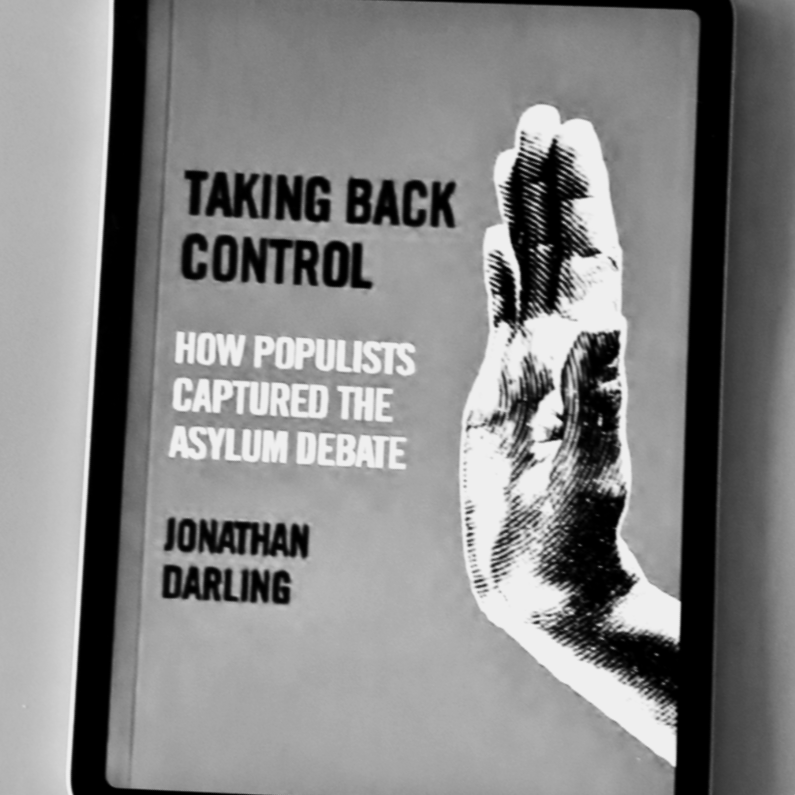
Taking Back Control by Jonathan Darling
How much does a country owe strangers in danger, compared with its own people, and who should decide? Few questions in British politics stir as much feeling.
It is beyond doubt that a nation ought to protect and prioritize its own citizens first.
So why on earth should it owe strangers anything to begin with?
The answer, at least in Britain's case, was solidified in 1951.
In the aftermath of the second world war, governments were compelled to confront the shame of the 1930s, when Jews fleeing Nazi Germany found one border after another barred against them. Britain admitted some, among them roughly 10,000 children carried to safety on the Kindertransport, but, like America and others, it turned many more away, and some of those rebuffed later perished in the Holocaust. Chastened, states put their names to the Refugee Convention, Britain among the earliest.
The rationale was at once moral, (“we should never let this type of bat crap shit happen again"), reciprocal (“any nation's citizens might one day be victim in this type of shit”) and pragmatic (“since shit happens and people will flee war regardless, common rules are preferable to chaos”).
The obligation is also narrower than is commonly supposed. It does not compel Britain to admit all comers. It requires only that the state hear the claim of anyone who seeks its protection, and that it refrains from returning a bona fide refugee to peril. Those still awaiting a verdict are “asylum seekers”; those whose claims succeed then become “refugees”.
Some seven decades on, that undertaking is under considerable strain, and its fraying is the subject of Taking Back Control by Jonathan Darling, a geographer at Durham University who has long scrutinised Britain's asylum system. The title, lifted from the slogan of the 2016 Brexit campaign, is pointedly chosen. The book spans the years between Boris Johnson's landslide in 2019 and the general election of 2024, during which the pledge of "control" over Britain's borders migrated from Brussels to the beaches of Kent.
The book’s thesis can be stated in a sentence: the asylum debate was "captured" by right-wing populists, and policy came to be judged less by whether it worked than by whether it was seen.
How much does it cost to deport nobody? In Britain's case, at least £240 million.
That is what the government paid Rwanda under a plan to fly asylum seekers there for good. The logic, in effect, ran: “we promised to help these people, but oopsies we would rather not have them here, so we will ship them to east Africa instead hehe.” The courts blocked it, a new government cancelled it, and not one plane ever took off. £240 million wasted.
To the author, that is the key to the whole book: the plan was never really about sending people away, but about being seen to try.
Darling begins by demonstrating that the ground had been laid long before. In the early 2000s a Labour government erected a separate, threadbare support system for asylum seekers and dispersed them wherever housing came cheapest, with no say in the matter. In the 2010s Theresa May, then home secretary, pledged "a really hostile environment" for illegal migrants, deputising landlords, doctors and employers as auxiliary border guards. The intent was to render life so arduous that people would neither come nor stay. Darling observes that it barely dented the numbers, yet it taught a generation of politicians that the appearance of toughness could count for more than its efficacy.
He handles the statistics with welcome care. Asylum applications climbed from roughly 36,000 in 2019 to some 82,000 in 2024. That has the ring of an explosion, yet it remained below the peak of 2002, and Britain ranked a modest 17th in Europe for applications per head. The graver failing lay within the Home Office, whose decision-making slowed to a crawl: by the end of 2023 a backlog of 95,300 people languished in limbo, some for years. (While they wait, asylum seekers are largely barred from working, so the state must house and feed them.) Nesrine Malik, a columnist Darling quotes, diagnoses "a crisis by design, not of arrivals". The government's remedy came in two statutes. The first, in 2022, sorted asylum seekers into two tiers according to how they had arrived. The second, in 2023, decreed that anyone entering by an irregular route, such as a small boat, must be removed, irrespective of their circumstances. In Darling's reckoning this all but abolished the right to claim asylum in Britain, the very promise sketched above.
The core of the book traces four symbols, one per chapter, each of which distilled a labyrinthine system into a single, potent image.
Boats. Small-boat crossings were virtually unheard of before 2018. That December the home secretary curtailed a family holiday to declare a "major incident" over 248 arrivals. Before long Nigel Farage was filming six exhausted people trudging up a Kent beach and branding it a "shocking invasion". By 2024 some 37,000 people a year were making the crossing, and 73 perished in the attempt. Darling advances a point ministers will find uncomfortable: years of fences, dogs and scanners at Calais sealed off the less conspicuous routes, in the backs of lorries and through the tunnel, and drove people onto the water, in full view of the cameras. (Why attempt the crossing at all? There is scarcely any means of applying for asylum in Britain from abroad; one must be on British soil to ask. Many are drawn by a smattering of English or by family already settled there.) Nor were most of them opportunists: 68% of small-boat claims since 2018 have succeeded. The government's schemes for deterring them ranged from "floating walls" to "wave machines" to repel the dinghies. Most were abandoned within weeks, but they kept charities perpetually occupied in rebuttal, which, Darling suggests, was rather the point.
Hotels. When the pandemic struck in 2020, asylum seekers were decanted into empty hotels as a stopgap. With decisions so sluggish, the stopgap hardened into the system. By June 2023 more than 400 hotels housed some 51,000 people at a cost of £8m a day; a hotel bed cost roughly £158 a night, against £20 in conventional housing, and the private contractors involved reaped handsome profits. Tabloids decried the "luxury". Charities documented mould, bed bugs and food so meagre that parents struggled to nourish their children. If the boat came to embody a loss of control over the border, Darling contends, the hotel embodied a loss of control over the public purse. Hence hotels became lightning rods for protest, stoked by far-right activists filming outside; and hence, in the riots of summer 2024, a mob set fire to a hotel in Rotherham with asylum seekers still inside.
Barracks and barges. To demonstrate its resolve, the government moved people into disused army barracks in Kent and Wales and, in 2023, onto the Bibby Stockholm, a barge moored off Dorset. These sites were designed to look forbidding, and duly did. At Napier barracks more than half the residents contracted covid; at Manston, a processing centre built for 1,600 but crammed with over 4,000, a diphtheria outbreak claimed the life of a man from Iraq. The barge packed 506 people into 222 cabins built for one apiece, and in December 2023 a young Albanian resident died in an apparent suicide. When residents complained, a senior Conservative MP retorted that he had "stopped in worse accommodation in Skegness". The irony is that these camps were not even cheaper: the National Audit Office found them costlier than the hotels they were meant to supplant. Darling's explanation is that the barbed wire was there partly for the benefit of the public peering in. It was, in effect, a stage set.
Flights. Rwanda was the grand finale. Under the scheme, asylum seekers would be dispatched to Rwanda to have their claims adjudicated there; even if successful, they would never return. Its price, as noted, was prodigious: ministers alone spent over £400,000 shuttling to Kigali to sign and re-sign the deal. The courts proved a persistent obstacle. In 2023 the Supreme Court ruled that Rwanda was not safe, since refugees risked being sent on to danger. Rishi Sunak's government responded with legislation that simply declared Rwanda safe by fiat. Darling distils the approach thus: "If the law is inconvenient, change the law." Not a single flight had departed by the time Labour scrapped the scheme in 2024, leaving more than 50,000 people stranded in legal limbo.
Why does the subject never recede? Darling identifies a "salience cycle". Commentators proclaim migration the public's foremost concern; ministers respond with a theatrical announcement; the ensuing coverage magnifies the issue; and the clamour for harsher measures intensifies. No policy is ever severe enough to break the shit show. He calls the upshot "performative cruelty": measures that are punitive, conspicuous and addressed more to voters than to migrants, such as Rishi Sunak donning a stab vest to observe an immigration raid, or Mickey Mouse murals painted over in a children's reception area for being "too welcoming". (It helps that asylum seekers are not citizens and cannot vote, so severity towards them carries no electoral cost.) The vocabulary shifted in tandem. By 2024 even the BBC routinely described small-boat arrivals as "illegal migrants". Darling counters that, under the 1951 convention, seeking asylum is no crime, however one arrives.
The concluding chapter contends that the change of government altered less than many anticipated. In the summer of 2025 protests erupted anew outside a hotel in Epping, in Essex. Labour abandoned Rwanda chiefly on grounds of cost rather than principle, ran advertisements in the visual idiom of Reform UK, and has proposed that refugees wait 20 years rather than five before they may settle permanently. Reform UK, for its part, now speaks of deporting 600,000 people and withdrawing from the European Convention on Human Rights. Darling closes with a set of pragmatic proposals: permit asylum seekers to work after six months; offer a one-off amnesty to nationalities whose claims are almost invariably upheld (94% of Sudanese applicants in 2024, for instance), so as to clear the backlog and empty the hotels; return asylum housing to the stewardship of local councils; and brief residents early, before rumour fills the void.
Here the original question resurfaces, and both answers merit a fair hearing. Proponents of "citizens first" make a serious case. A government's paramount duty is to its own people. Housing and sustaining asylum seekers is costly, no country can shelter all who seek refuge, and it is voters, not a treaty drafted in 1951, who ought to determine who may enter.
That conviction explains why Reform UK and many Conservatives now wish to withdraw from, or rewrite, these agreements. Their adversaries retort that the numbers are modest relative to a population of nearly 70m, that the bulk of the world's refugees are sheltered by poorer countries bordering war zones, and that a wealthy nation reneging on its word would embolden others to follow suit.
Darling is firmly ensconced in the second camp, and candidly describes his own tone as one of "indignation". His proposals are judicious, yet he affords the "citizens first" argument too little consideration, treating it chiefly as an artefact of populist stagecraft rather than a sincerely held conviction shared by many voters. Populist stagecraft is true, but the legit concerns of British citizens can also be true. In my opinion, that is what the author can consider a bit more.
The book’s strength lies in demonstrating, through a wealth of detail, how readily an intractable moral question can be converted into theatre. Whatever one believes Britain owes to strangers, squandering hundreds of millions on flights that never left served neither them nor its own citizens.