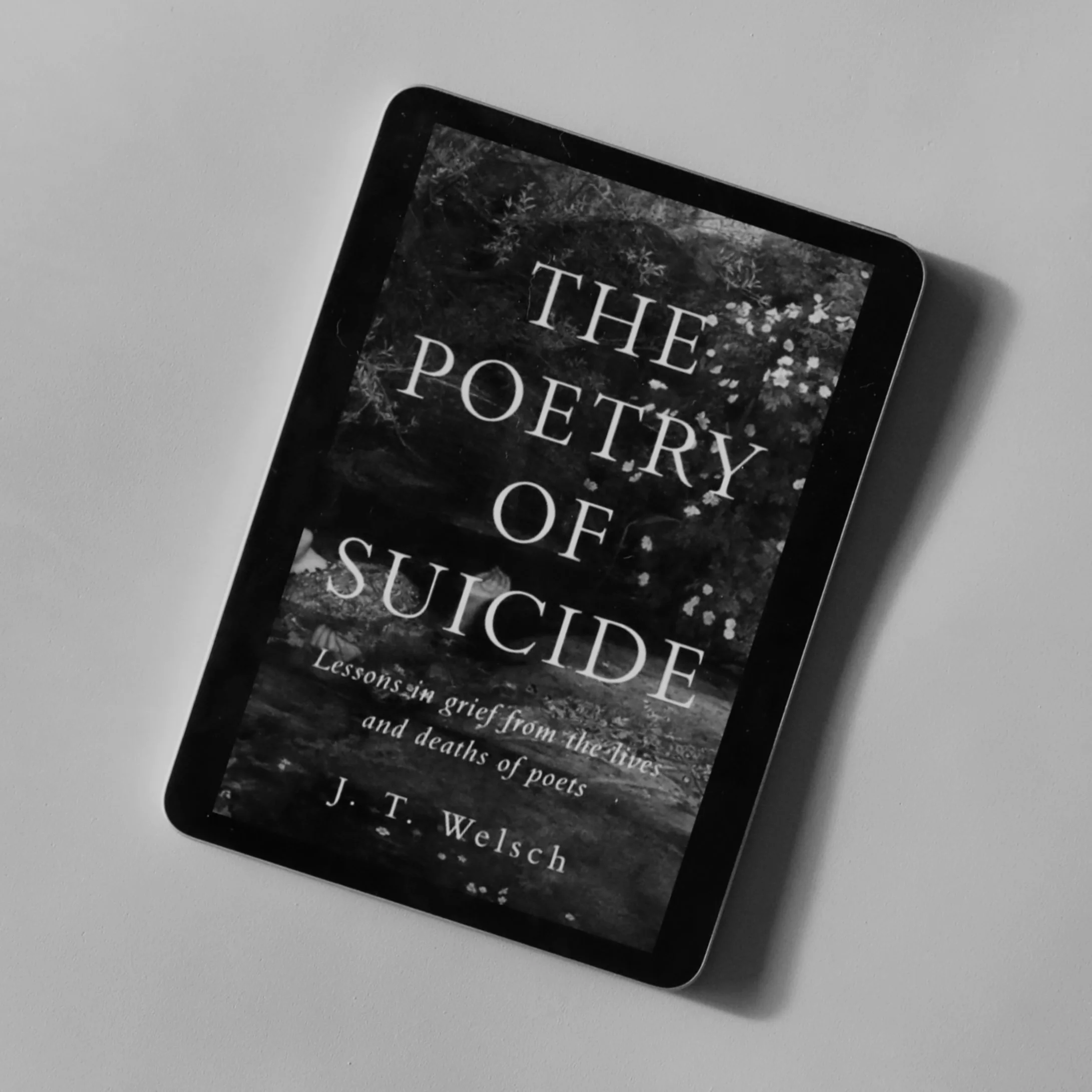
The Poetry of Suicide by J.T Welsch
What is suicide?
Is Socrates, drinking hemlock at the state’s command, a suicide? Is the soldier who throws himself on a grenade to protect civilian counted as one? The spy who swallows cyanide rather than speak? The 108-year-old woman in chronic pain who ends her life? The Japanese samurai who sliced his own stomach to take responsibility? Are all of these acts to be gathered under a single definition—and, if so, are they all to be read as mental illness or clinically depressed?
Has prohibiting ways of speaking ever enlarged understanding? It rarely has.
In societies that pride themselves on pluralism and freedom of thought, it is striking how readily a single authorized language for suicide is accepted.
Modern discussions of suicide are restrained to an unusual degree. The shift began with Durkheim’s Suicide (1897), which recast a moral and philosophical question as a social phenomenon legible through statistics that are measurable, classifiable, explainable. The twentieth century deepened this framework: Freud and Menninger theorized the suicidal mind, while suicidology emerged as an interdisciplinary field uniting sociological, psychological and biological approaches.
This medicalized paradigm now holds near-hegemonic authority. As Ian Marsh notes, it is difficult to discuss suicide without invoking pathology—typically depression or a disturbed mental state. Margaret Pabst Battin describes this as a “uniform assumption”: suicide is treated as the causal product of illness. The framework is so dominant that to question it can seem irresponsible.
Public language has become carefully policed. Media guidelines urge restraint: avoid sensationalism, omit methods, do not romanticize. These prescriptions are grounded in evidence as language do have contagion effects. These prescriptions mean well.
Suicide is, and should remain, a sensitive subject handled with care.
Yet, care can shade into control.
Efforts to standardize how suicide is discussed risk producing an unintended intellectual contraction. To narrow the language is, subtly, to narrow the thought. When one vocabulary, medical, therapeutic, becomes obligatory, alternative lenses, ethical, cultural, philosophical, are edged out. The result is not just caution but conformity: a complex human phenomenon rendered singular and speakable in only one way.
Constrained speech rarely expands thought or deepen understanding.
“Let’s talk about suicide,” one says, and we flinch;
yet Hamlet’s “To be or not to be, that is a question.” passes as philosophy.
The book Poetry of Suicide by J.T. Welsch seeks to widen the aperture through which society understands suicide. At its core lies a simple yet provocative premise: like poetry, suicide resists definitive interpretation, and it should be open to discussion. To understand suicide is not to encourage it. Yet, in the name of sensitivity and control, society has largely urged silence instead.
“What is suicide?”
The author dismantles the apparent obviousness of suicide, arguing that it is far less stable than everyday usage suggests. What seems a straightforward description of self-inflicted death is in fact the product of a long entanglement of linguistic invention, philosophical dispute, legal classification and cultural interpretation. Suicide is not timeless, but a modern conceptual framework—its meaning shifting with the language that contains it.
The point is sharpened by a linguistic curiosity: Hamlet, literature’s most famous meditation on self-inflicted death, never uses the word. It did not yet exist. Coined in 1643 by Thomas Browne in Religio Medici, the term sought to replace morally loaded phrases such as “self-murder” with a more neutral vocabulary. This marked a broader shift—from a theological framework, where self-killing was sin, to a secular, quasi-scientific language of classification. Yet neutrality proved nebulous. Christian doctrine condemned the “self-killer,” while antiquity celebrated figures such as Cato the Younger and Lucan for their voluntary deaths. Browne’s terminology attempted to reconcile these traditions, distinguishing between condemned and honourable acts. From the outset, suicide was less a definition than a compromise. As the term spread across 17th century Europe, its neo-Latin form lent it a clinical, even bureaucratic tone, replacing overtly accusatory expressions. But this apparent neutrality flattened distinctions. As Michael Cholbi notes, while law carefully differentiates forms of homicide, self-inflicted death is typically collapsed into a single category.
This compression quickly breaks down under scrutiny. Definitions premised on intention unravel when faced with edge cases: the death of Socrates, ordered to drink hemlock; the soldier who falls on a grenade; the spy who takes cyanide. Are these suicides, sacrifices, or something else? Even theology hesitates, drawing uneasy distinctions between martyrdom and self-sacrifice. At precisely this boundary, language falters. The stakes are not merely semantic. As Cholbi observes, classification carries practical consequences: it shapes psychiatric treatment, legal outcomes, insurance claims and public-health data. Yet despite decades of effort—from Émile Durkheim to Edwin Shneidman—no stable definition has emerged. A 2006 World Health Organization panel conceded that universally unambiguous criteria may be impossible.
The book therefore advances a more radical claim: suicide does not precede language but is constituted by it. A death becomes suicide only through acts of recognition—coroners’ verdicts, medical assessments, cultural narratives. As Katrina Jaworski argues, these practices render deaths legible as suicide. Language does not merely describe; it produces. The term’s clinical tone has encouraged a medicalized understanding, while alternatives—Jean Améry’s “voluntary death” or Ian Marsh’s “self-accomplished death”—attempt to recover lost nuance. Each reveals the inadequacy of the single word. A personal anecdote underscores the point: a rumour of suicide imposed a narrative upon a death, one powerful enough to reshape memory itself. Naming, the author suggests, does not simply reflect reality—it constructs it.
The same holds more broadly. Public discourse assumes that sufficient causal knowledge might explain suicide definitively. Yet, like poetry, it resists closure. Its meaning is assembled through interpretation, never fixed. No more than a poem can a suicide be reduced to a single, authoritative account.
What I like about this book is that rather than concentrating on Anglo-American literature alone, the book surveys poets from across continents and decades, situating their lives and works within shifting historical and cultural contexts. In doing so it seeks to illuminate what the historian Marzio Barbagli calls suicide’s “infinite variety”: the ways in which the meaning of suicide changes across time and place.
Throughout the book, the author shows that poetry and suicide have always been entwined in the cultural imagination, often in ways that border on cliché. The figure of the doomed poet, consumed by melancholy and artistic sensitivity, remains stubbornly persistent. The genealogy of this myth stretches far back: from the ancient Chinese poet Qu Yuan 屈原, who reputedly drowned himself in the Miluo River in 268 BCE, to the Romantic fascination with the teenage poet Thomas Chatterton, whose death in 1770 became immortalised in Henry Wallis’s painting. Twentieth-century literary history offers no shortage of similarly tragic figures: Vladimir Mayakovsky, Paul Celan, Sylvia Plath. Plath’s suicide in 1963, occurring a year after Marilyn Monroe’s death, proved especially influential in shaping modern perceptions of the relationship between creativity and despair.
Poetry occupies a peculiar threshold between private and public speech. Lyric poems externalize interior states—thoughts, emotions, conflicts—yet they do so in language that inevitably participates in broader cultural discourse. This ambiguity makes poetry a particularly fertile medium for approaching suicide, itself a phenomenon suspended between individual experience and collective interpretation.
Such an approach aligns with broader developments in contemporary suicide research. Increasingly scholars describe suicide as the outcome of a complex interplay of factors: sociocultural pressures, traumatic experiences, personality traits, psychiatric conditions and genetic vulnerabilities. Poetry offers one such methodology. Poems capture intensely private experiences—internal conflicts, emotional turbulence, the voices of the dead—but they also function as cultural artefacts, shaped by collective assumptions about suffering and death. Poetry is therefore not merely a passive container for ideas about suicide; it actively participates in shaping those ideas.
Yet the author is careful to resist any suggestion that suicide should be aestheticized or normalized. Discussion of an existing act is not normalizing or encouraging it. Ultimately the book concerns not the act of suicide itself but how societies interpret it. Scientific research, public policy and medical language have undoubtedly deepened understanding. Yet they cannot capture the full emotional and cultural texture of the phenomenon. Poetry, with its tolerance for ambiguity and contradiction, offers another vocabulary—one capable of articulating experiences that resist clinical description.
If the modern era has taught us to analyse suicide statistically and medically, The Poetry of Suicide suggests that it must also be read.