
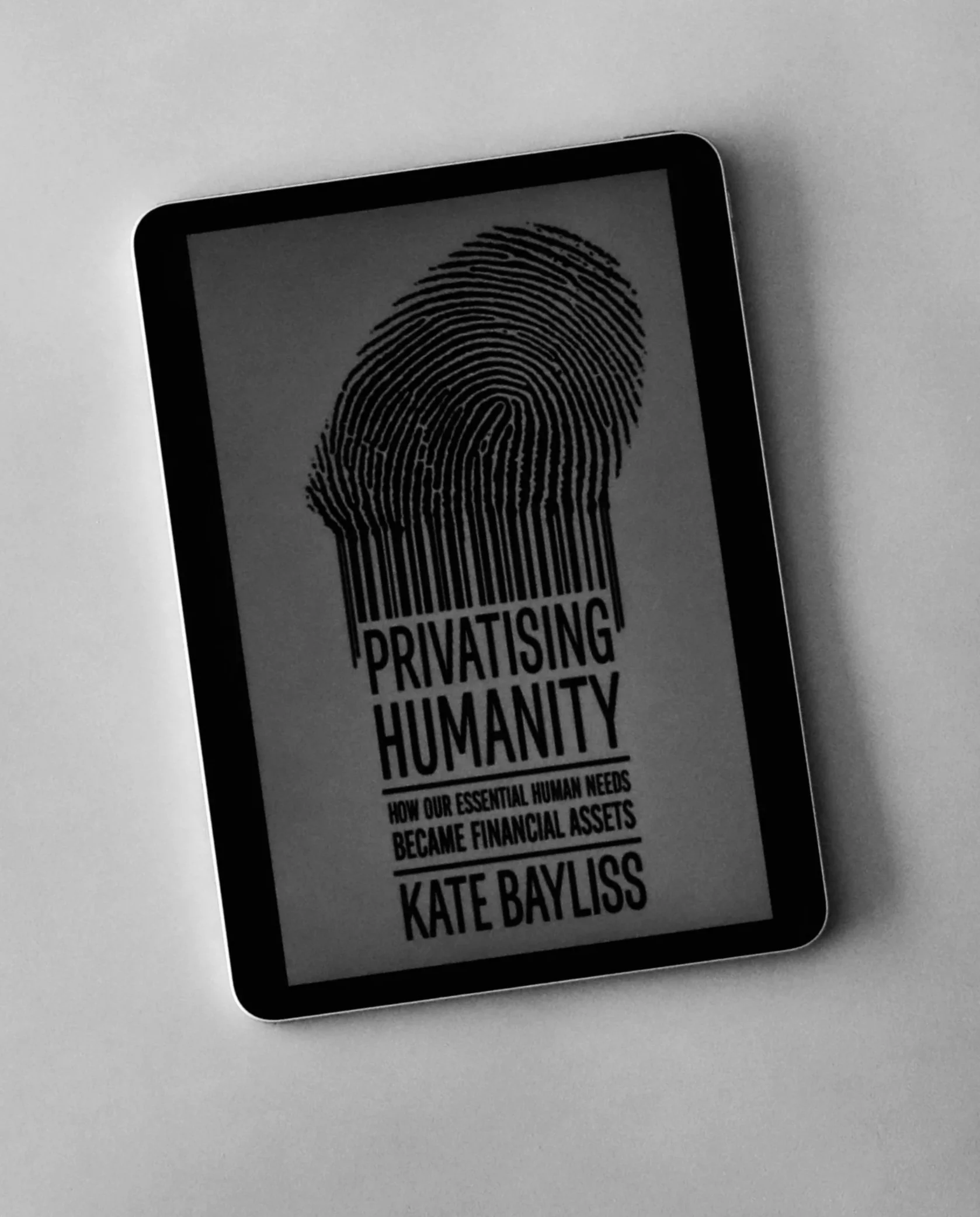
Privatising Humanity by Kate Bayliss
Few ideas are as quietly disquieting as the one at the heart of Privatising Humanity. Kate Bayliss’s contention is not simply that essential services have been privatized. It is that the act of living itself has been reorganized into a series of revenue streams. To turn on a tap or a light, or to inhabit a home, is no longer merely to consume. It is to participate in a system designed to extract.
The book opens with a paradox that has become uncomfortably familiar. Britain remains a wealthy country, yet many of its citizens are not. Stagnant wages, rising costs and widening inequality are well documented. Bayliss’s contribution is to shift attention from symptoms to structure. The cost-of-living crisis, she suggests, is not an aberration. It is the logical outcome of a model in which basic needs are treated as financial assets. The book’s main focus is on three sectors that admit little room for avoidance: water, energy and housing. These are not discretionary purchases. Demand is inelastic and payment is unavoidable. Precisely for that reason, they have proved fertile ground for financialization. Ownership is fragmented across complex and often global chains. The simple act of paying a bill becomes the end point of a longer process through which value is extracted and redistributed. Households fund not only services, but dividends, interest payments and capital gains accruing elsewhere.
This inversion is the book’s central insight. Essential services have not merely been outsourced, they have been absorbed into the logic of finance. Risks are frequently socialized, especially when systems fail. Returns, by contrast, remain firmly private. The result is a model in which the public underwrites stability while investors capture upside.
Bayliss’s argument reminded me of a book I read years ago, What Money Can’t Buy, by Michael J. Sandel. Sandel asks whether there are certain goods that should not be allocated by markets at all, not because pricing them is impossible, but because doing so corrupts its meaning. Life, civic duties such as voting or military service, even the prohibition against slavery, are not merely constrained by feasibility but by moral boundaries. To put a price on them is to risk corrupting what they represent (the meaning of being a citizen, the meaning of life etc.). Privatising Humanity does not go so far as to suggest that essential goods like water or housing should be free. Rather, it raises a subtler question: whether it is appropriate for markets to be the primary mechanism that assigns their value. Even if markets can increase efficiency and in theory “enlarge the economic pie”, it does not follow that the extra pie are distributed in a way that reflects social priorities.
Bayliss opens the discussion by narrating the economic ideological shift within the late 20th century. Post-war Britain, shaped by the Beveridge settlement, prioritized universal provision. From the 1980s onward, that model gave way to one rooted in market principles. Privatization began as a response to fiscal constraint but evolved into a broader creed. Markets were not only more efficient, they were deemed superior arbiters of resource allocation.
The historical account is useful in puncturing any sense of inevitability. Privatization was neither planned nor empirically assured. Assets were often sold at prices designed to secure uptake rather than maximize public value. Financial markets, particularly in the City of London, emerged as clear beneficiaries. The process did not simply transfer ownership. It reoriented the provision of public services toward the needs of investors from the outset.
From there, Bayliss turns to a set of familiar claims. The first is that privatization brings investment. In practice, private capital rarely arrives without conditions. It demands returns, typically higher than those required for public borrowing. The Private Finance Initiative illustrates the point. Upfront investment translates into long-term payment obligations that frequently exceed the value of the assets created. What flows out, in other words, is greater than what flows in.
A second claim concerns efficiency. Here Bayliss is cautious. The public sector is not presented as a paragon. Rather, the concept of efficiency itself is interrogated. Cost reductions can improve short-term financial metrics while eroding long-term capacity. Maintenance is deferred, staffing reduced, wages compressed. These may register as gains on a balance sheet, even as service quality deteriorates. Nor is there any guarantee that efficiencies, where they exist, are passed on. They are as likely to accrue to shareholders.
Competition forms the third pillar of the privatization case. In theory, it disciplines providers and benefits consumers. In practice, many essential services exhibit the characteristics of natural monopolies. Entry barriers are high, infrastructure costly, and consumers lack both information and mobility. Competitive rhetoric persists, reinforced by regulatory frameworks, but the underlying conditions rarely resemble the textbook model.
Regulation is intended to bridge this gap. Bayliss is skeptical of its effectiveness. Regulators operate with incomplete information and often lag behind the firms they oversee. The risk of capture, whether overt or subtle, is ever present. Shared professional networks, revolving doors and asymmetries of expertise all shape outcomes. Regulation becomes less an external constraint than an arena of negotiation, one in which investor interests remain influential.
At this point, however, in my personal opinion, the argument begins to smooth over some of the messier realities it seeks to expose. In emphasizing the failures of privatized systems, the book risks implying a cleaner counterfactual than history quite supports. The public sector that preceded privatization was not a neutral or consistently benevolent provider. Many nationalized industries in 1970s Britain were marked by inefficiency, underinvestment and political interference. Nor is it obvious that the absence of profit would eliminate rent-seeking altogether. It might simply relocate it, from shareholders to bureaucracies or politically connected interests.
A similar compression appears in the treatment of finance itself. Bayliss is right that private capital extracts returns, often at significant cost. Yet governments turned to it not only out of ideology, but constraint. Fiscal pressures, investment needs and the desire to shift risk off public balance sheets all played a role. Private finance is more expensive in part because it prices risk explicitly, whereas public borrowing can obscure it. The relevant comparison, therefore, is not between idealized public provision and flawed private markets, but between imperfect systems on both sides, each with its own distribution of costs, risks and incentives.
The book does not argue for the wholesale exclusion of private capital. Rather, it questions its current dominance. Examples from Scotland and parts of Europe suggest that alternative arrangements can yield different outcomes. Public ownership, stronger oversight and a reorientation toward service provision offer plausible counterpoints. The implication is that the present model is contingent, not inevitable.
What the book does well is to reframe the question. What are essential services for? If the answer is to meet human needs, then the current system appears misaligned. If it is to generate returns, then it is performing effectively. The discomfort arises from recognizing how far the latter objective has come to dominate. The infrastructures that sustain daily life have been integrated into financial circuits. In the process, the relationship between citizen, state and provider has shifted. Individuals are less participants in a collective system than sources of predictable income.