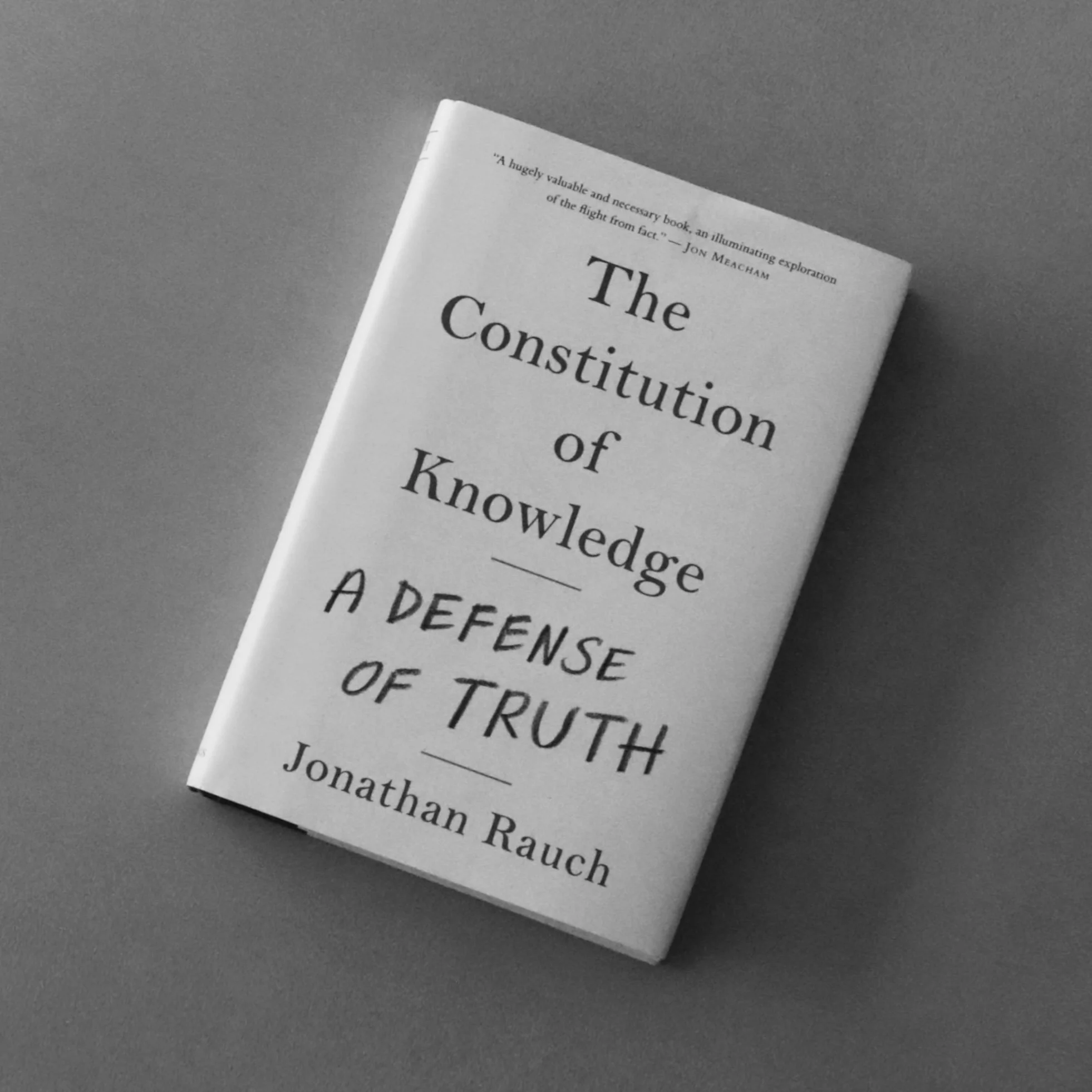
The Constitution of Knowledge by Jonathan Rauch
It is tempting to believe that human reasoning skills evolved for the purpose of discovering objective truth, if that exists at all.
However, the historical record suggests something less flattering.
Human beings appear to have developed reasoning abilities largely to persuade others, defend prior commitments, justify tribal loyalties, and outmaneuver rivals in argument. Long before modern psychology catalogued confirmation bias, motivated reasoning, groupthink, anchoring bias, in-group favoritism, and innumerable other cognitive distortions, thinkers already suspected that the human mind was not an instrument for truth-seeking but an ingenious attorney retained in the service of prejudice.
From an evolutionary standpoint, this arrangement makes perfect sense.
Human cognition was shaped not in laboratories but in tribes, where social cohesion mattered more than accuracy. Under such conditions, natural selection rewarded socially adept coalition-builders rather than truth-seekers. Intelligence evolved not merely to understand reality, but to navigate status hierarchies within it. Modern cognitive science has merely mapped the machinery beneath this condition: confirmation bias, framing effects, anchoring bias, availability bias, fluency bias, perseverance bias, and identity-protective cognition all demonstrate the same uncomfortable truth. The mind is not a pristine instrument of logic intermittently corrupted by bias. Bias is built into the architecture itself.
Yet, one may ask, if human cognition is so profoundly biased, tribal, and irrational, how does reliable knowledge emerge at all?
Jonathan Rauch’s The Constitution of Knowledge begins precisely where this problem leaves off.
Rauch’s answer is simple: throughout history, civilization eventually solved the problem institutionally rather than psychologically. The great achievement of liberal science was not the production of rational individuals, because such people do not exist, but the construction of a social system capable of correcting individual irrationality.
Knowledge, in other words, is not primarily a property of isolated minds. It is an emergent property of networks.
The book reaches back to the 18th century and traces this epistemic transformation through thinkers such as Montaigne, Bacon, Locke, Hume, Peirce, and Popper.
The intellectual genealogy begins with Michel de Montaigne, whose skepticism bordered on epistemic demolition. Montaigne observed that human beings inherit beliefs “by authority and on credit,” then deploy reason merely to fortify them afterward. Men disagree endlessly because no two individuals perceive the world identically, and because every conviction feels self-evidently true from the inside. From this, Montaigne arrived at a devastating conclusion: if disagreement is universal, perhaps certainty itself is impossible. Worse still, if authorities disagree among themselves, who adjudicates between them? The epistemic problem collapses into Hobbes’s political question: who will rule the rulers?
The problem of truth was not merely philosophical; it was social. Knowledge depended not simply on what I know, or what YOU know, but on what WE can collectively verify.
Francis Bacon then attempted to rescue knowledge from Montaigne’s abyss by redirecting inquiry away from inherited dogma and toward empiricism. Bacon believed that systematic observation and experimentation could overcome what he called the “Idols” of the mind: distortions arising from human nature itself, from personal limitations, from language, and from inherited systems of thought. Bacon proposed a way for people with radically different beliefs to settle disputes in a laboratory.
John Locke deepened this transformation. Knowledge, he argued, does not descend from revelation, metaphysical certainty, or abstract axioms detached from experience. Claims must be checkable against observation and reason. Locke understood that untestable certainties are socially explosive. Once individuals believe their convictions are divinely guaranteed, compromise becomes betrayal. The consequence is perpetual sectarian warfare. Empiricism therefore became not merely a method of inquiry but a political ethic: a system designed to channel disagreement into judiciable forms.
This was a radical reorientation of intellectual life. For centuries, philosophers had sought certainty in revelation, pure reason, metaphysics, or the authority of philosopher-kings. Yet the emerging empiricists increasingly abandoned certainty altogether.
David Hume intensified skepticism by arguing that causation itself cannot be known with absolute certainty. No amount of observation can definitively prove that future events will resemble past ones. From there, Charles Sanders Peirce and later Karl Popper developed the doctrine of fallibilism:
knowledge is possible not because certainty exists, but precisely because certainty is unnecessary.
Popper’s reformulation was especially influential. Science advances not by proving ideas true once and for all, but by systematically exposing ideas to potential falsification. Human beings naturally sanctify their beliefs. Liberal science institutionalizes the opposite instinct. It creates mechanisms for destroying bad ideas before people destroy one another over them.
Science progresses not because scientists are unbiased, but because claims are continuously exposed to criticism, falsification, replication, and revision.
The author argues that objectivity does not reside within any single mind. It exists socially, within networks. Science’s credibility lies not in perfection but in self-correction. It works precisely because scientists are biased, stubborn, competitive, and eager to expose one another’s mistakes. Different biases collide and partially neutralize one another. Rationality emerges collectively rather than individually.
The historical examples are particularly effective. Nineteenth-century geology descended into bitter tribal conflict between Neptunists and Vulcanists, complete with ridicule, factionalism, and ideological camps. Yet the dispute was eventually resolved not through coercion or authority but through the gradual accumulation of evidence. Likewise, modern scientific progress depended not merely upon isolated geniuses such as Newton, but upon journals, universities, laboratories, peer review, professional associations, and international scholarly networks. Newton alone could not have created modern science. The network mattered as much as the mind.
This leads to a broader argument about liberal civilization itself. Modern institutions such as science, constitutionalism, peer review, and adversarial journalism are built upon skepticism toward human rationality rather than faith in it. Their strength lies precisely in assuming that human beings are biased, self-interested, tribal, and status-conscious—and constructing systems through which truth can nevertheless emerge from organized criticism and distributed error correction.
The constitution of knowledge succeeds because it generates three public goods:
knowledge, freedom, and peace.
A successful epistemic system must produce reliable knowledge, preserve intellectual freedom, and channel disagreement away from violence. Liberal science accomplishes this not by eliminating conflict, but by transforming conflict into a process of inquiry rather than sectarian warfare.
Yet, we are moving backwards. Disinformation. Trolling. Conspiracies. Social media pile-ons. Campus intolerance. Cancel culture. Triggering. Politically correctness.
Modern society, Rauch warns, may be losing not merely its grasp on truth, but its very capacity to produce knowledge. He argues that the epistemic framework sustaining liberal democracy, the open, self-correcting process of criticism, verification, and institutional scrutiny through which societies gradually converge upon reality, is now under assault from multiple directions simultaneously. Social media algorithms reward outrage over accuracy; conspiracy movements cultivate distrust toward all institutions; political tribalism fragments citizens into rival realities; and ideological conformity increasingly punishes dissent rather than testing ideas through debate. Rauch is particularly alarmed by the growing climate of fear surrounding public discourse, in which individuals self-censor on controversial subjects not necessarily because they believe alternative views are false, but because the reputational consequences of voicing uncertainty or heterodox opinions have become prohibitively severe.
In such an environment, speakers are ostracized rather than argued against, while public denunciation and tribal loyalty increasingly eclipse intellectual curiosity and honest inquiry. The danger, in Rauch’s view, is profoundly civilizational. Liberal democracy presupposes the existence of some shared factual world; once objective truth dissolves into competing partisan narratives and fear replaces open criticism, democratic discourse itself begins to deteriorate into tribal conflict, eroding one of society’s primary mechanisms for correcting error and producing reliable knowledge.