
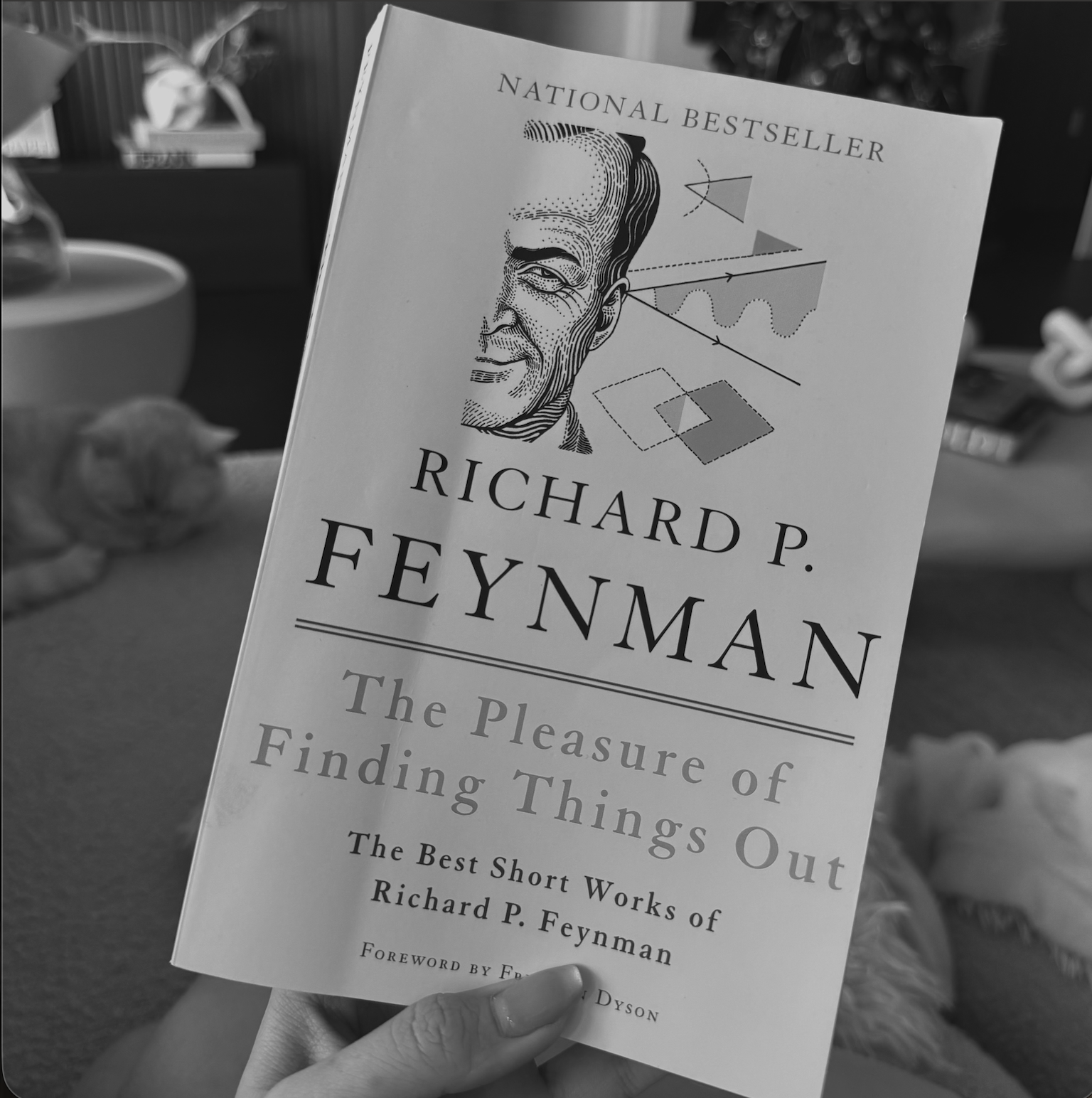
The Pleasure of Finding Things Out by Richard Feynman
Step on a bathroom scale and about 99% of what it reads is not the stuff you're made of.
By now we all know we're made of atoms, and that an atom contains protons, neutrons and electrons, and that protons in turn are made of quarks.
But weigh every quark and electron in your body separately, add them all up, and you'd get about 1% of the number on the scale.
The other 99% isn't material. It's energy: the motion and churn going on inside every proton in you, right now, constantly. A tiny part of our mass is made up of matters, but a majority, energy.
We have now proved it, but for a long time nobody could.
In 1981, asked in a BBC interview what he was working on, physicist Richard Feynman described a problem he'd been stuck on for years.
Feynman was looking at what we now call quantum chromodynamics, he had the theory, a perfect calculation of the mathematics, but can’t perform the actual calculation, it drove him nuts.
It starts with something strange. Two electrons can be pulled apart as far as you like, and the further apart they get, the weaker the force between them. Quarks ought to behave the same way. Smash particles together hard enough and the quarks should come flying out. They never do. What comes out is always a jet of new hadrons. Never a single quark on its own.
So why do the equations for quarks, which differ from the electromagnetic ones by only a few small terms, produce the exact opposite behaviour?
I first heard of Richard Feynman from one of my favorite TV shows The Big Bang Theory, where his name surfaced so often it began to function as shorthand for genius itself. A Nobel laureate in theoretical physics, a founding figure in quantum field theory, recruited to the Manhattan Project and worked on the atomic bomb aka one of the century's more conspicuous minds. And yet I never read a word of him.
Physics, I assumed was far too hard for someone without a science background, and that quantum physics in particular was too abstract to be any fun, with no examples you could point to in everyday life. So I never bothered to read him or understand even a little.
I'm not claiming I could now open one of his papers. But the training turns out not to be the price of entry. Feynman left a great deal written for everyone else, lectures and interviews and short pieces, and it was one of those collections, The Pleasure of Finding Things Out, that I happened to pick up. What it taught me first was that there is a pleasure of finding things out, the fun in sitting with a question you cannot yet answer.
So, back to the bathroom scale.
Actually, Feynman never got there. In 1974 Kenneth Wilson found the way through: chop spacetime into a grid and grind through it by brute force. The numbers themselves took supercomputers, thirty years later.
The answer was that quarks can't be pulled apart at all. What holds them is a particle called the gluon, and unlike anything in electricity, its grip doesn't weaken with distance. It holds steady, like a rubber band that never slackens, until you've poured in so much energy that the band snaps and that energy becomes a fresh pair of quarks. Trapped in a space that small, the quarks move at nearly the speed of light. Gluons, meanwhile, carry the very charge they transmit, so they spawn more gluons, which spawn more still. The inside of a proton isn't three marbles on strings. It's a boiling field.
A hot pot of coffee weighs heavier than the same cup cold for the same reason. Weigh the pot and you weigh the boiling. Energy is mass (E=mc²), though there the difference is far too small to measure ourselves at home.
In conclusion, your material parts don't add up to you!! Mass isn't additive. The weight of matter comes mostly not from the material, but from the energy running through it. I find this fairly interesting.
So if Feynman never got to see the result, why the hell did I bring it up in this book review? Because the problem is in the book. In one chapter he lays out this business of quark behaviour in the plainest, most conversational way, so plainly that I went looking for the answer myself. It felt like time travel: catching up on thirty years he never got.
That's the pleasure of this book. It gathers the best of Feynman's short work, interviews, speeches, lectures and printed articles, and the range is wide: his philosophy, childhood episodes with his father, his views on religion, the theories that defeated him, his thoughts on where science sits in our culture, his Nobel Prize acceptance speech. What holds it together is a life in science shown up close, and never in a way that shuts an ordinary reader out.
It's surprising how far one person's scattered thoughts can carry you, and how easily they send you down a rabbit hole. The rabbit hole of the pleasure of finding things out.
Which answers the question of how you review a collection called The Pleasure of Finding Things Out. You do the thing it's named after.
I also wanted to note the topics I found interesting in this collection. It holds his 1959 lecture "There's Plenty of Room at the Bottom," in which he imagines building machines atom by atom, decades before any field existed to attempt it. It holds his minority report on the Space Shuttle Challenger disaster, where he takes apart not only the failed component but the culture of managers who had convinced themselves the odds were better than they were. It holds the speech on scientific integrity that gave us the phrase "cargo cult science," for research that wears the costume of the thing without the substance. And it holds "Los Alamos from Below," his account of arriving at the Manhattan Project with his thesis still unfinished, sitting in rooms with Oppenheimer and Bohr, and watching the first test. Freeman Dyson wrote the foreword. Alongside all this are the pieces you'd expect: the childhood lessons from his father, his views on religion and education, the Nobel speech, his thoughts on where science sits in the culture.
Feynman treated doubt as the working condition of an honest mind rather than a failure of nerve, and the collection's real argument is that uncertainty is not the thing standing between us and our understanding; it is the beginning of understanding. Readers won’t finish this book and all of a sudden able to do physics. But we may finish it unable to leave a question alone, which is the more contagious inheritance, and the one Feynman seems to have wanted to pass on.