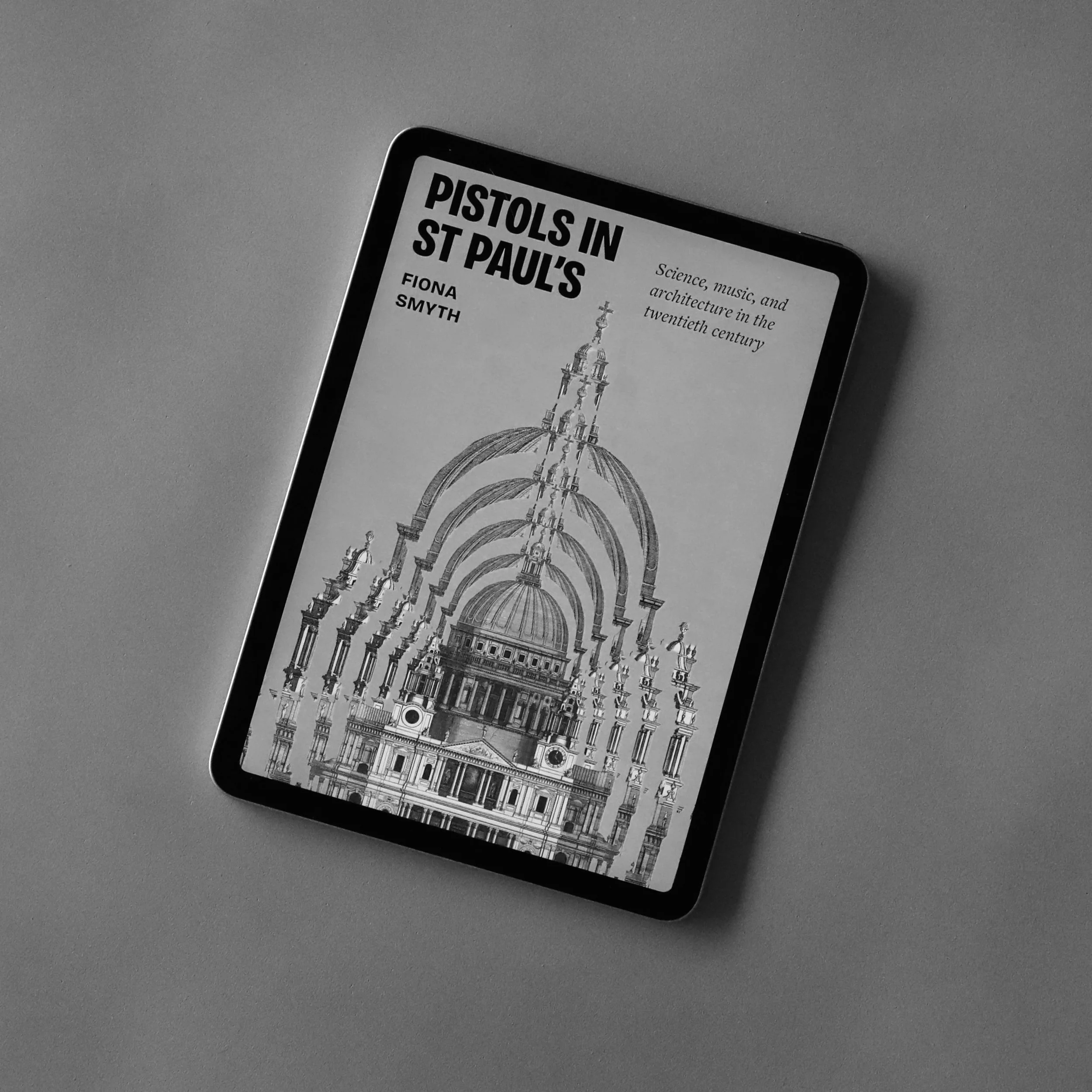
Pistols in St Paul’s by Fiona Smyth
Apparently, one perfectly respectable way to conduct scientific research in 1951 was to fire a gun inside St Paul’s Cathedral.
On a December evening, a series of shots rang through the cathedral, each reverberating for almost twelve seconds before disappearing into silence. Scientists and architects were not testing ballistics or staging some eccentric act of sacrilege. They were measuring the building itself: using the pistol as a sharp burst of sound to study how the vast interior absorbed, distorted, and returned it.
It is difficult to imagine a better opening for Fiona Smyth’s Pistols in St Paul’s, a history of architectural acoustics in Britain between 1901 and 1951. Smyth’s subject initially sounds almost aggressively specialized, quite daunting for readers who did not specialize in architecture…like myself, but later it is shown that the book revolves around a much simpler question: How do we translate something as subjective as experience into something science can measure?
We know almost immediately whether a room sounds good.
Just like the sound quality of a good speaker vs lousy headphone. Music can feel warm, thin, brilliant, muddy, intimate, or distant. Attaching numbers to those impressions is considerably harder. Smyth traces the period when architects, physicists, musicians, and engineers began trying to do precisely that.
Building is a musical instrument. Architecture does not simply contain sound; it participates in producing what we hear. Materials, surfaces, furnishings, dimensions, and even the bodies occupying a room alter its acoustic character. By the middle of the twentieth century, buildings could effectively be “tuned.” Yet Smyth resists presenting this as a neat story in which intuition was steadily replaced by science. The history is much messier.
At the beginning of the century, acoustics occupied an uncertain territory between art and science. Wallace Clement Sabine’s work on reverberation supplied a mathematical framework that would become foundational to modern architectural acoustics, but formulas did not automatically resolve all problems. Smyth repeatedly shows theory colliding with budgets, aesthetics, professional egos, and the inconvenient fact that human beings do not experience sound as equations.
Some of the book’s most memorable episodes therefore involve failure. London County Hall became notorious for acoustics so poor that reporters complained of hearing several syllables simultaneously. Newspapers dubbed its council chamber the “hall of murmurs.” More revealingly, acoustic recommendations had reportedly been rejected partly because of cost and visual impact. Good acoustics could be viewed as incompatible with the dignified appearance expected of civic architecture. One contemporary attitude amounted to: win the architectural competition first and fix the sound afterward.
That tension between measurement and human judgment runs throughout the book. At White Rock Pavilion, for example, architects wanted to produce a particular “musical tone,” yet terms such as warmth, brilliance, balance, blend, and clarity had no agreed numerical equivalents. In architectural literature of the 1920s, “tone” was still more commonly associated with paint than sound. Scientists and musicians first had to develop a shared language before subjective impressions could become usable design criteria.
I found this one of Smyth’s most persuasive ideas. We often imagine quantification as the opposite of subjectivity, as though sufficient data eventually eliminates human judgment. Pistols in St Paul’s suggests something subtler. Subjective experience frequently determined what scientists needed to measure in the first place. Numbers did not abolish listening; they became another way of listening.
The story becomes stranger in the 1930s, when acoustics was respectable enough to attract an industry but not regulated enough to prevent dubious claims. St Paul’s received proposals for products promising to conquer its notorious echo. One invention, the “Klarial,” produced little discernible improvement, yet its inventor nevertheless advertised it as having eliminated the cathedral’s echo. There is something wonderfully modern about this episode: a new technical field emerges, commercial enthusiasm races ahead of standardization, and institutions struggle to distinguish innovation from marketing.
Smyth is equally good at showing how scientific development depends on political circumstance. During the Second World War, official architectural acoustic research largely stopped, yet exceptions were granted when music was considered important to national morale. After Queen’s Hall was destroyed, Hope Bagenal was allowed to modify the Royal Albert Hall so the Proms could continue. Similar acoustic work at St Paul’s and other buildings was justified by cultural and social necessity. The ability to hear music clearly had become entangled with morale, civic life, and the question of what ought to survive a war.
These threads converge at Royal Festival Hall in 1951. Rather than treating the building as a finished object to be tested, its designers adjusted its acoustics during construction. Nearly 3,000 concertgoers attended one test while the auditorium remained unfinished, sitting on cushions on bare concrete, while their reactions were collected alongside scientific measurements. Beethoven’s Coriolan Overture was repeatedly performed, pistol shots punctuated the music, insulation was added or removed, and even the orchestra platform used different materials beneath different groups of instruments.
The result was not universally loved. Some listeners admired Festival Hall’s extraordinary clarity, while others felt that science had made itself almost too audible, producing an unfamiliar and somewhat clinical aesthetic. Its achievement was therefore not the discovery of a mathematically perfect concert hall, but the creation of a process in which architects, scientists, musicians, critics, and listeners could argue about what “good” sound meant and then attempt to build it.
If the book has a weakness, it is almost inseparable from its strength. Smyth has undertaken an extraordinary amount of archival excavation, and the density of correspondence, committees, institutions, experiments, and professional relationships occasionally allows the larger argument to recede behind the evidence. Hope Bagenal, the acoustician who acts as the book’s central human figure, helps hold the narrative together, but there are passages where I found myself more impressed by the completeness of the research than absorbed by the story.
Still, that density serves a purpose. Smyth’s real achievement is to show how untidy innovation actually is. Architectural acoustics developed through formulas, certainly, but also through failed buildings, newspaper ridicule, commercial opportunism, wartime improvisation, bureaucratic obstruction, musical judgment, and people simply sitting in rooms deciding whether they liked what they heard.
Perhaps that is the most interesting lesson of Pistols in St Paul’s. Science became much better at measuring buildings, but it never made the human ear irrelevant. Somewhere between the reverberation formula and the person sitting in the concert hall remained the stubborn question that animated the field from the beginning: not simply what does this building sound like, but what do we want it to sound like?
And occasionally, answering that question required a pistol.