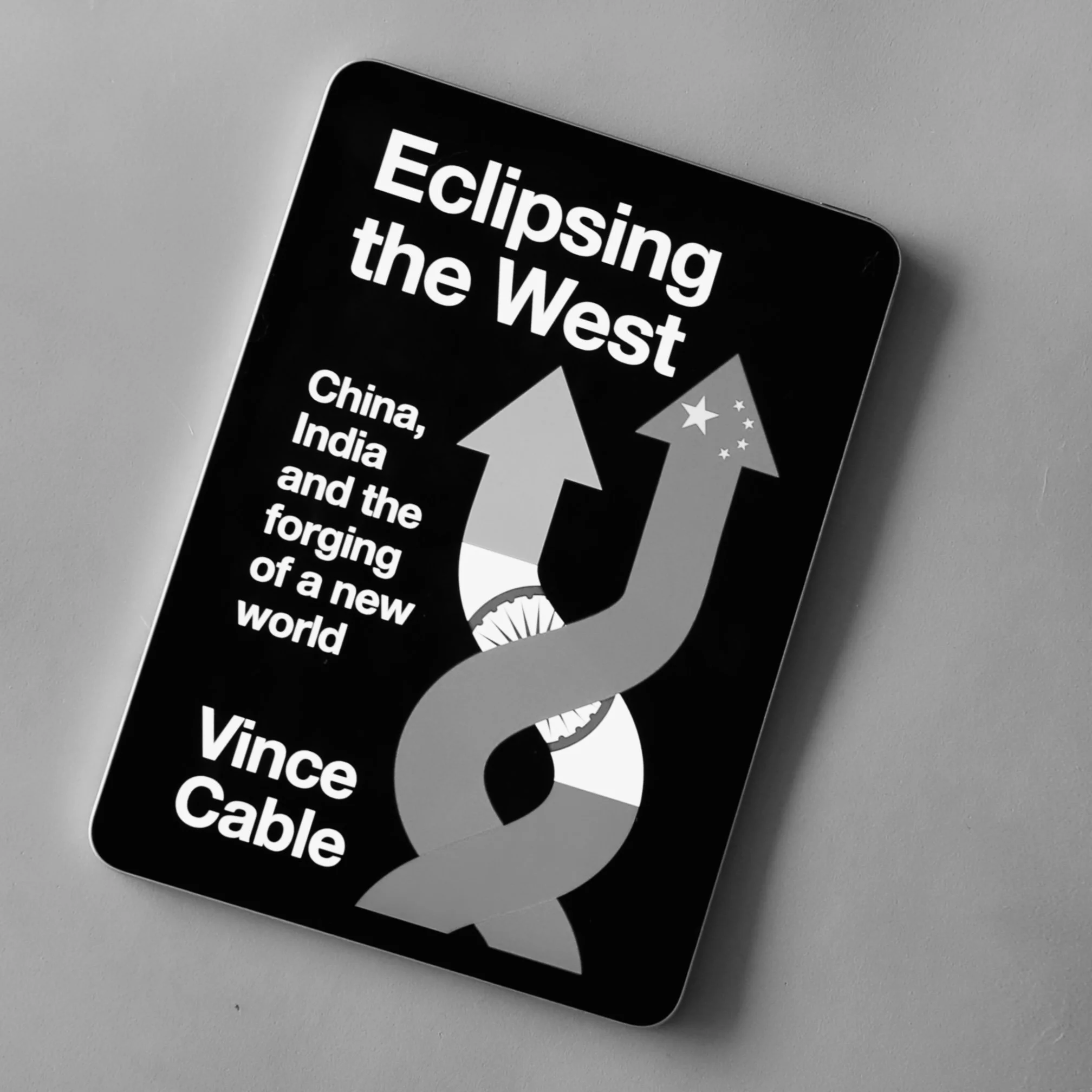
Eclipsing the West by Vince Cable
I had assumed “frenemy” was a word I had safely left behind in high school, along with the petty politics of adolescent friendships. Apparently, they are just everywhere.
What does a “frenemy” look like in the political realm?
Perhaps two countries that clash over borders, distrust each other’s strategic ambitions and quietly prepare for the possibility of conflict, yet still trade extensively, participate in the same multilateral forums and cooperate whenever their interests happen to converge.
China and India are almost a textbook example of this contradiction.
They both seek substantial reform of international institutions to better reflect their growing economic weight. Both resist Western criticism of their approaches to human rights and secessionist movements, both maintain close relations with Russia, and both are potentially vulnerable to Trump’s tariff wars.
Their relationship is neither friendship nor straightforward rivalry, but an uneasy coexistence in which competition and cooperation frequently occur in tandem.
This tension sits at the heart of Eclipsing the West written by Vince Cable.
China and India may diverge sharply in political systems, developmental trajectories and strategic priorities, but they also share something more consequential: scale. Together they account for an enormous share of the world’s population and an increasingly substantial proportion of its economic output, giving them the capacity to reshape institutions largely constructed under Western predominance. The book’s central question is therefore not simply whether China or India will overtake the West, but what happens when the global order must accommodate two rising “superstates” that are simultaneously rivals, partners and beneficiaries of the very system they increasingly seek to reform.
The distinction between a superpower and a superstate is important. Neither China nor India yet possesses the full combination of military reach, financial dominance and soft power historically associated with American supremacy. But their enormous populations, domestic markets, productive capacity and increasingly sophisticated technological ecosystems confer advantages that smaller states simply cannot replicate. On a purchasing power basis, China is already larger than the United States, while India ranks third, although calculations based on market exchange rates produce a markedly different hierarchy.
The book can roughly be divided into two questions. First, how did China and India arrive here? Second, what happens to the international system when they do?
The first question produces the stronger half of the book.
China and India make an unusually tempting comparative experiment. Both emerged into their present political forms in the late 1940s, both were desperately poor, both embraced socialist planning and industrialization, and both possessed vast populations and civilizational histories considerably older than the Western states whose economic development they hoped to emulate. Yet their subsequent trajectories diverged dramatically. China became the factory of the world. India largely missed the great era of export-led manufacturing. China became much richer, more urbanized and considerably healthier. India remained poorer but is now growing faster.
The conventional explanation is wonderfully simple. China had authoritarianism; India had democracy. One government could build roads, relocate populations and restructure industries without asking permission. The other had elections, unions, courts, regional governments, protests and the inconvenient habit of citizens saying no.
But the book is much too careful to leave the argument there.
One of its more interesting observations is that China and capitalist democratic India have converged upon different versions of something resembling the same economic system: state capitalism. Both contain substantial private sectors alongside considerable state direction. Both exhibit intimate relationships between government and large business. Both struggle with corruption. Both liberalized economies that had previously been dominated by planning, but China moved earlier, faster and with considerably greater enthusiasm for foreign capital. India proceeded more hesitantly and often inconsistently. More recently, their trajectories have partially reversed, with Xi Jinping imposing tighter political constraints upon business while India has continued, however imperfectly, to liberalize.
There is a particularly intriguing paradox here. China is, in important economic respects, more decentralized than federal India. Deng’s reforms encouraged provincial and local officials to experiment, compete and pursue development, while Indian government remains surprisingly concentrated above the local level. China therefore combines political centralization with a considerable degree of economic localism; India combines political federalism with administrative centralization. It is precisely this kind of comparison that makes the book persuasive, because ideological labels are repeatedly displaced by the less glamorous but far more revealing mechanics of institutions.
The chapter on democracy and autocracy performs a similar service. The usual Western narrative presents India and China as convenient representatives of two competing political systems. Liberal democracy competes against authoritarian capitalism and eventually, one hopes, history announces a winner.
Reality is less accommodating.
India remains a genuine electoral democracy, and the endurance of mass democracy in a poor, enormous, multilingual and multireligious society is itself remarkable. But the book is attentive to the erosion of liberal institutions under Narendra Modi, including pressures upon political opposition, civil society, the press and the judiciary. China, meanwhile, possesses none of India’s electoral accountability, yet its state can often administer policy and enforce ordinary law more effectively. The result is not equivalence, and the book does not pretend otherwise. Suppression of political opposition in China remains of an entirely different magnitude. But the distinction between a perfectly democratic India and perfectly autocratic China is nevertheless far less analytically useful than it initially appears.
I found this part particularly persuasive because it avoids turning economic development into a morality play. Democracy may offer advantages in accountability, representation and institutional checks, but that does not mean every democracy will govern more effectively or grow faster than every dictatorship. Likewise, the ability of an authoritarian government to build infrastructure quickly or implement policy decisively does not establish that authoritarianism is inherently superior. Different political systems may function differently depending on a country’s size, level of development, institutional capacity and social conditions. Strong governments can make consequential decisions quickly. They can also make very large mistakes quickly. Democracies may correct those mistakes more readily, but they can also suffer from political fragmentation and protracted decision making. Neither system, in other words, possesses a monopoly on effective governance.
The more interesting question is whether Xi’s political centralization is now beginning to erode precisely the economic dynamism created by the earlier, more experimental Chinese system. The book is notably resistant to the fashionable “peak China” thesis. China faces a property crisis, an aging population, diminishing returns on investment and increasingly intrusive political control. Yet it also possesses extraordinary manufacturing depth, rapidly advancing scientific capacity and companies that have progressed far beyond merely replicating Western technology. The author ultimately inclines toward the view that predictions of Chinese stagnation are once again being overstated.
India has almost the inverse problem. Its demographics appear enviable, its productivity growth is improving and its economy retains considerable scope to converge with richer countries. But possessing hundreds of millions of working-age people is advantageous only if they can be employed productively. India’s failure to generate sufficient jobs, particularly manufacturing jobs, remains one of the most serious obstacles to the endlessly invoked “demographic dividend.” China industrialized by absorbing rural labor into factories. India has produced world-class software engineers while leaving enormous numbers of less educated workers confined to low-productivity agriculture and informal employment.
This is where I think the tortoise and hare metaphor, which recurs throughout the book, becomes slightly misleading. India is not simply China twenty or thirty years behind. Its trajectory may be structurally different. A services-led economy, a more fragmented political system, weaker state capacity and a substantially smaller role in global manufacturing cannot simply be inserted into the Chinese developmental model with the dates moved forward.
The second half moves from comparative political economy into geopolitics and becomes both more ambitious and more speculative.
The emerging international system is organized around two traps. The first is the familiar Thucydides Trap, in which a rising power and an established power become drawn toward conflict. The second, and to me the more interesting, is the Kindleberger Trap: the danger that an old hegemon ceases to provide international public goods before any emerging power is willing or capable of assuming responsibility for them.
This distinction matters. The problem created by American relative decline is not merely that China might fight the United States. It is that nobody may be willing or capable of sustaining the institutions upon which everyone nevertheless depends.
Climate change provides perhaps the clearest example. China is simultaneously one of the world’s largest emitters and arguably its most consequential producer of technologies required for decarbonization. India will become increasingly important simply because of the scale of its future energy consumption. Both therefore become indispensable participants in any meaningful environmental settlement. Yet geopolitical antagonism encourages precisely the opposite behavior: self-sufficiency, energy security and continued reliance upon coal. Climate cooperation increasingly depends upon countries that profoundly distrust one another.
Something similar occurs in trade, finance and security. The postwar international system was never as impartial as its defenders sometimes suggest, and China and India have legitimate reasons to ask why institutions created when Western economies dominated the world should indefinitely preserve the same distribution of authority. At the same time, neither Beijing nor New Delhi appears particularly eager to inherit the costs and obligations that accompanied American hegemony.
India is particularly fascinating here. It is simultaneously a member of the Quad, which exists largely to constrain China, and BRICS, which exists partly to challenge Western predominance. It purchases Russian oil while deepening economic relations with the United States. It invokes the Global South while pursuing its own regional primacy. This is not incoherence. It is what the book describes as “multi-alignment,” a world in which countries increasingly reject the binary logic of a new Cold War.
China and India themselves therefore return to the idea with which the book begins: frenemies. They share grievances about Western control of international institutions and frequently cooperate through BRICS and other organizations. Yet they also distrust one another profoundly, compete for influence across Asia and remain divided by a disputed border upon which soldiers have already died. The possibility that the defining Asian conflict of the century might ultimately be China versus India rather than China versus America is one of the book’s more sobering observations.
The final chapter offers three possible futures. One resembles a renewed Global West in which India draws closer to the United States and China becomes increasingly contained. Another is a genuinely multipolar system, with large states pursuing sovereignty and self-interest in the absence of a hegemon. The third envisages renewed multilateralism after some sufficiently terrifying crisis finally persuades governments that cooperation is preferable to catastrophe.
I confess I found the third scenario the least convincing. The book itself acknowledges its improbability. Economic depression, climate catastrophe, nuclear escalation or another pandemic might finally compel the major powers to cooperate. But “perhaps catastrophe will make everyone sensible” feels less like a political mechanism than the point at which scenario building exhausts its mechanisms.
The numerical projections should likewise be treated cautiously, as the author repeatedly warns. Depending upon assumptions about productivity, exchange rates and growth, India might rival or even surpass both China and the United States by mid-century. China might remain vastly larger than America. Or the gaps may narrow far more gradually. Compound growth allows modest differences in assumptions to generate enormous divergences over twenty-five years. These figures are therefore more useful as illustrations of how radically the hierarchy could change than as literal forecasts. The book itself explicitly cautions against taking its projections too seriously.
This leads to my principal reservation about the book. Eclipsing the West is a wonderfully provocative title, but it implies a somewhat stronger claim than the analysis itself requires. Aggregate GDP is not synonymous with geopolitical supremacy. America possesses deep capital markets, elite universities, extensive alliances, technological ecosystems, formidable military capabilities and a globally dominant currency, none of which can be replicated merely by becoming larger in PPP terms. China and India may become economic giants while remaining substantially poorer per capita than the United States. The book acknowledges all of this. Yet the gravitational pull of economic scale occasionally makes the argument appear more deterministic than its own evidence warrants.
Still, perhaps that is not the central point.
The more consequential argument is not that the West disappears, nor that China inevitably replaces America at the top of some imaginary league table. It is that the era in which Western countries could construct global institutions around their own preferences and describe the result as the international order is approaching its end. By the book’s reckoning, the world is moving toward three economic superstates: America, China and India. Economic weight will increasingly translate into political influence, technological leverage and, whether their governments welcome it or not, responsibility for global problems.
Overall, Eclipsing the West is most compelling when it dismantles binaries: democracy versus autocracy, capitalism versus socialism, China versus the West, alignment versus non-alignment. The world that emerges from its pages is considerably messier than any of these categories permit. China combines one-party rule with what the book at times describes as “Communist capitalism.” India is democratic and increasingly illiberal. Both cooperate and compete with the West, and with each other. America is declining relatively while remaining extraordinarily powerful.
Perhaps the real eclipse, then, is not of the West itself. It is of the comfortable assumption that the West can continue to be treated as the natural center around which everyone else revolves.