
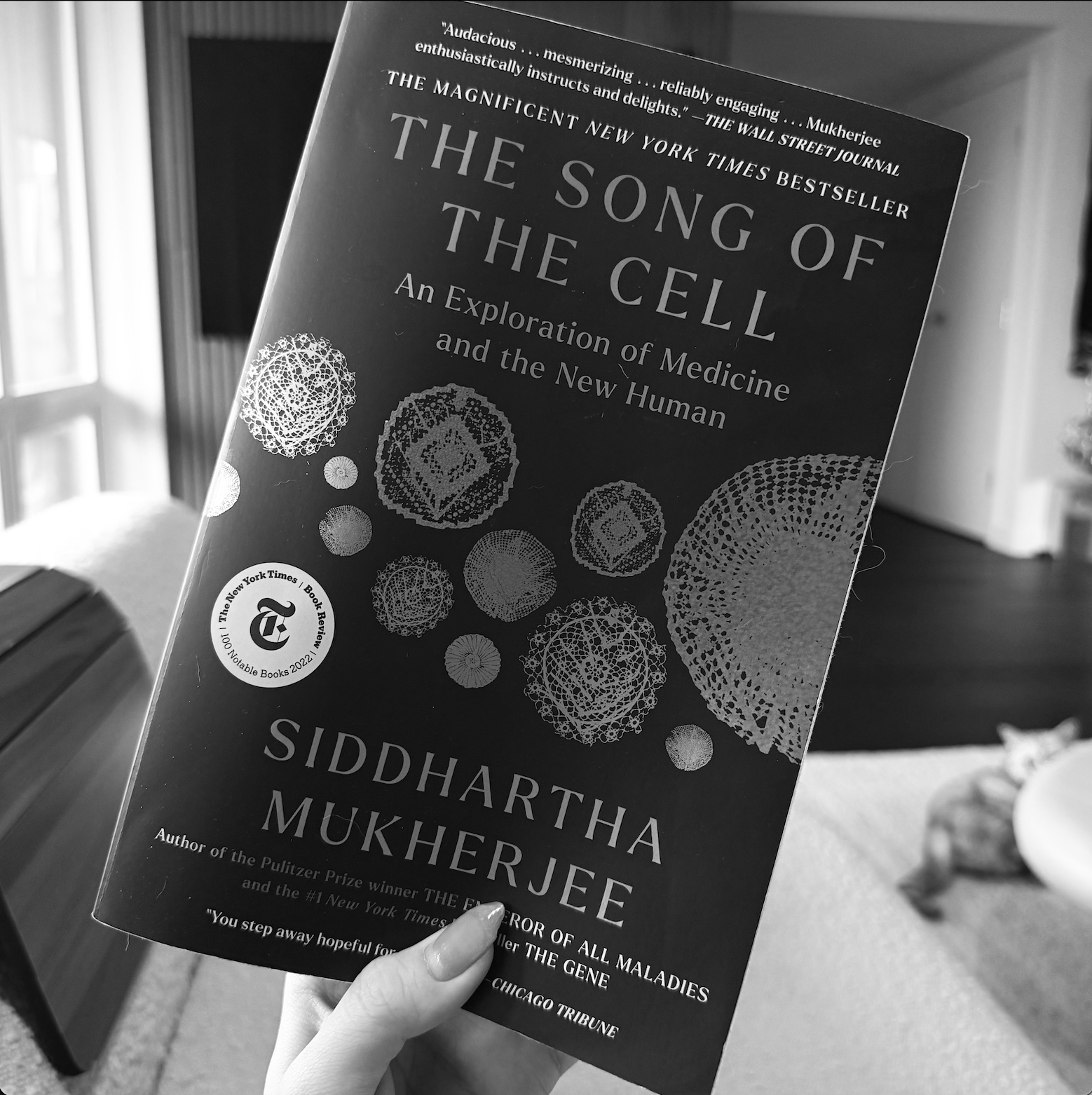
The Song of The Cell by Siddhartha Mukherjee
How does the body detect a Trojan horse once it has already been carried within the walls?
Imagine a virus replicating inside a cell, concealed from the immune system’s direct view and therefore seemingly free to multiply unchecked. The body’s defences patrol outside the cell, while the invasion is unfolding within.
How, then, can the immune system know that the sneaky Achaeans have already passed within the walls?
The answer lies in one of biology’s most elegant systems of surveillance: a specialized molecule known as MHC class I. Perfectly shaped for its task, it gathers fragments of proteins from inside the cell and escorts them to the surface, where they are displayed to the body’s immune sentinels. In effect, the cell offers up a small sample of what is taking place behind its own walls. This is as if our immune system being served an “amuse-bouche” of the cell’s interior. Through this modest act of revelation, the intruder is made visible, and the infected cell is sentenced to destruction.
What makes this mechanism even more unnerving is how recent our understanding of it is. The MHC class I pathway was not fully understood until the late 1980s, a fact I found chilling, not least because it reveals how many discoveries now indispensable to modern medicine have taken place within my own lifetime. The same pathway is also targeted by SARS-CoV-2, which helps explain, at least in part, why Covid proved so deadly.
I tend to abandon whatever else I am reading when Siddhartha Mukherjee has something new to say. The last Mukherjee book I read was The Emperor of All Maladies, a sweeping account that places his work as an oncologist within the larger, centuries-long history of cancer and the evolution of medicine itself. With his new book, he shifts the scale of inquiry from the imperial vastness of cancer to the intimate architecture of life itself: the cell, at once microscopic and immeasurably consequential.
The Song of the Cell is a history of biology told through its most fundamental unit, but it is also an account of medicine’s gradual change in scale. For centuries, physicians treated the body as an assemblage of organs, fluids and visible symptoms. The discovery of the cell forced a more radical proposition: that life, disease and repair must be understood not from the body downward, but from the cell upward.
Mukherjee traces this shift with his usual breadth, moving from the early microscopists who first saw cells without quite knowing what they had seen, to the theorists who made the cell the organising principle of living matter. In this telling, the cell is never merely a biological component. It is a citizen, a witness, a conspirator and sometimes a traitor. Blood cells carry oxygen and memory. Immune cells patrol the boundaries between self and invader. Neurons produce consciousness out of electrical whispers. Cancer cells, most ominously, expose the terrifying consequence of cellular autonomy: life turning its own generative powers against itself.
The book’s force lies in showing that the history of medicine is, in large part, the history of learning where to look. Once disease could be located in cells, it could be reimagined. Infection became an invasion of cells. Cancer became a rebellion within them. Immunity became a question of cellular recognition. Degeneration, deficiency and repair all acquired a new definition. The body became a republic of microscopic actors, each obeying rules, sending signals and, at times, breaking faith with the whole.
Some random details I find interesting in the book are as follows: Patients with Parkinson’s disease appear to have a markedly lower risk of cancer. Why? Fascinating. This is, at first glance, an almost perverse biological bargain. Why should a disorder of cellular attrition seem to confer some protection against a disease of cellular proliferation? Can medicine learn to appropriate the trick?
Then there is in vitro fertilisation, a technology that has long since escaped the confines of its original definition. IVF can assist conception; it can also be used to screen embryos for certain mutations. That much is familiar. But Mukherjee points toward something still more consequential: IVF as a possible arena for gene editing itself. Ethical issues aside, one company is already working on gene-editing enzymes, delivered into liver cells, that could permanently reduce cholesterol levels before a child is even born.
The book is also a useful corrective against the lazier misunderstandings of evolution. A giraffe’s long neck did not emerge because generations of its ancestors nobly stretched themselves toward higher branches. Evolution is not ambition transmuted into anatomy. It is mutation filtered through selection.
And then there is the excellent story of Wolfgang Pauli, the quantum physicist as celebrated for his brilliance as for his belligerence. He is said to have read a student’s paper and pronounced it so poor that it was “not even wrong.” Mukherjee repurposes the anecdote to describe one of his own scientific misapprehensions, which gives the insult a more humane afterlife. It becomes a reminder that knowledge rarely proceeds by stately increments from ignorance to truth. More often, it advances by false starts, failed conjectures, and the occasional discovery that even one’s errors must be made more interesting.
Throughout the book, Mukherjee is especially interested in the moment when observation becomes intervention. Modern medicine no longer merely identifies cells or destroys those that misbehave. It increasingly seeks to replace, reprogramme and engineer them. Bone marrow transplantation, stem-cell therapy, immunotherapy and CAR T-cell treatment all belong to this new dispensation. They suggest a medicine that does not simply treat the consequences of disease, but attempts to alter the cellular terms on which disease becomes possible.
This book is not only a retrospective account of discovery. It is a book about a change in medical imagination. The cell began as an object under glass. It has become a site of diagnosis, a unit of therapy and, perhaps, the medium through which medicine will attempt its most ambitious bargain, not merely to prolong life, but to revise its machinery.